

Factory Scheduling Demo
Wood · Operations & Productivity
Certification per Microsoft Marketplace.
Evidence tier Source Confirmed · 9 captures on record
What the publisher says
As described on Microsoft Marketplace.
Factory Scheduling Optimization
Operations scheduling optimization
Show the rest of the publisher’s description (48 more lines)
is an important logistics problem that touches many industries. In this sample,
you will teach a Bonsai brain and harness the power of Deep Reinforcement
Learning and Machine Teaching to optimize scheduling inside a paint
manufacturing facility.
This sample is offered by Wood and
offers the following:
·
A
Discrete Event Simulation environment created out of Simply
·
The
Bonsai brain training inkling file
The problem statement for the
sample is as follows:
1.
There
is an aggregate order list of products with volumes and due dates from
customers
2.
The
manufacturing process consists of 4 steps: Mixing, Dispersion, Thin Down and
Filling. None of these process steps can be skipped
3.
Each
process stage has 4 different units with different capacities and processing
speeds. There is also a list of compatible products for each process unit. Not
all products are compatible with all machines
4.
When
switching from 1 product to another, there is a fixed changeover time of 30
minutes
5.
The
aim is to optimize the scheduling by reducing either the total makespan (time
to manufacture all batches), total number of changeovers or total delay (You
can choose which of these to optimize alone or in parallel while training your
Bonsai brain)
The training of the Bonsai brain
has been done with “action masking”, a new Bonsai feature because the number of
legal actions at each iteration varies in this problem. The simulator and Brain
have been architected in a way that you designate a process train for each
batch of product you want to manufacture (as opposed to choosing jobs for each
unit).
This sample is very handy for
testing scheduling optimization use-cases with Bonsai. Such an approach can be
fitted to many other manufacturing operations and is not limited to paint
manufacturing. Please feel free to reach out to Wood for any questions
regarding this sample.
Preview
1 image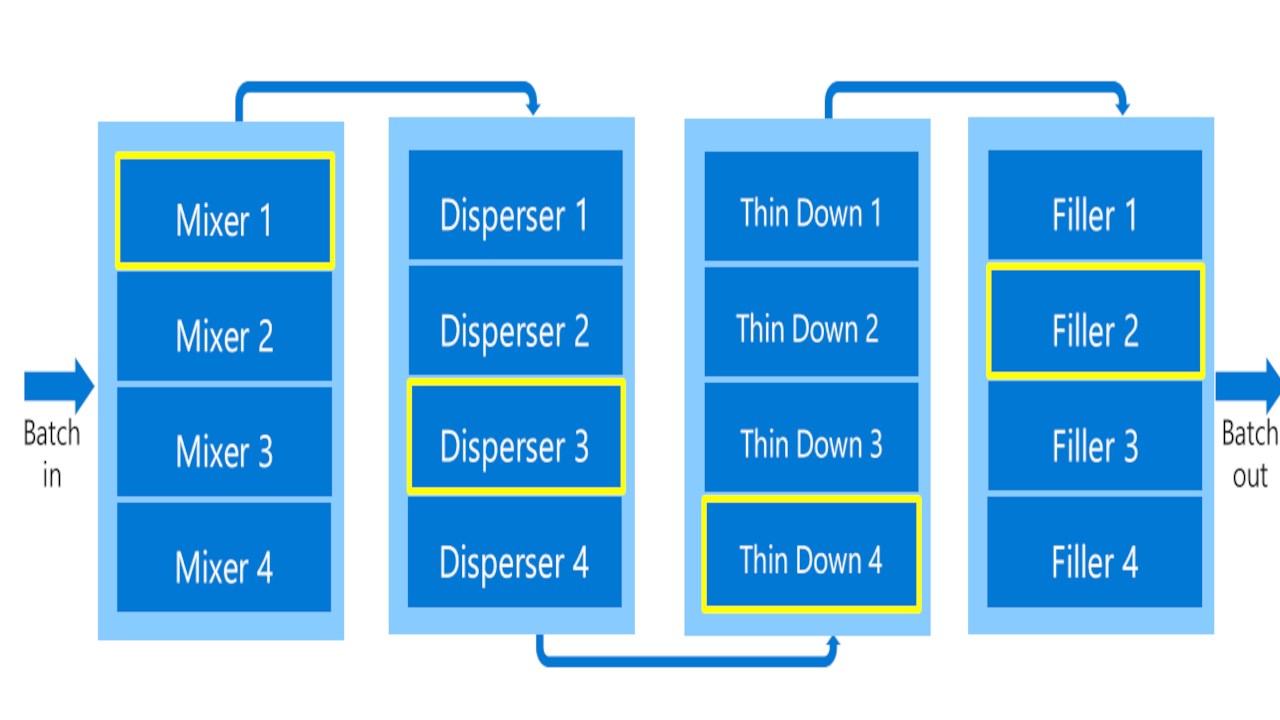
Agent build and provenance
See the full provenance
The layer-by-layer build, the evidence behind each claim, the risk basis and the cross-marketplace links are open to any account. Some rows are disclosed, some the source leaves Unknown; a free account shows you which.
Compliance
- FedRAMPConfirmedNot listed90%, registry-checkedNo FedRAMP Marketplace entry matched this vendor's domain, checked 2026-08-27registry recordas observed 2026-08-27
Confirmed means matched to a public authoritative registry. Claimed means the vendor or its listing states it, not yet cross-checked. A framework not shown was not found in any source we hold, which is not evidence against it. Not listed means a scoped registry check found no match for this vendor's domain: a No is a scoped registry check, not a compliance judgment. Confidence bands: 95% domain-verified, 90% registry-checked, 80% self-attested, 70% weak signal. Self-attested items marked “vendor's site” are gathered from the vendor's own website and are not verified by us.
Sources
Publisher resources
2 linksLinked repositories
Unknown means this listing does not publish a repository. It is not a statement that the code is closed, and a linked repository is not a claim that the publisher wrote it: the registry computes that relationship privately and does not publish it.
Evidence risk is the share of the build you cannot see before you deploy, not a security rating. Sign in to see the layer-by-layer basis for this band.