

tcpfn-foundry-model
PROFITOPS INC · Operations & Productivity
Certification per Microsoft Marketplace.
Evidence tier Source Confirmed · 6 captures on record
What the publisher says
As described on Microsoft Marketplace.
TCPFN is a transformer-based causal foundation model that answers "why" questions on industrial time-series data. Given raw multivariate sensor data from a plant historian, TCPFN infers the temporal causal graph connecting variables, traces observed events back to their root causes, and estimates the effect of candidate interventions. It does all of this zero-shot: no site-specific training, no labeled failure data, and no feature engineering.
Most industrial AI models are correlational. They can tell you that a quality deviation and a pressure drift move together, but not which one drives the other, or what will happen if an operator intervenes. TCPFN is built for the causal questions that determine action: what caused this event, what should we change, and what will happen if we do.
Show the rest of the publisher’s description (18 more lines)
TCPFN follows the prior-data fitted network (PFN) approach introduced by Muller et al. (arXiv:2112.10510) and popularized by TabPFN (Hollmann et al., Nature 2025). Instead of training on customer data, the model is pretrained once on millions of synthetic systems sampled from a prior over temporal structural causal models. At inference time it conditions on the customer's observed data in-context and outputs an amortized approximation of the Bayesian posterior over causal structure. Customer data is never used for training and never leaves the inference boundary.
Model architecture
- Transformer encoder, 21.6M parameters
- Pretrained for 200K steps on 30 million synthetic temporal structural causal systems
- In-context Bayesian inference: the model approximates the posterior over causal graphs and effects conditioned on the provided dataset
- Reference: Temporal Causal Prior-Data Fitted Networks, arXiv:2606.20889
Capabilities
- Causal Discovery
- Root Cause Analysis
- Effect Estimation
- Intervention Ranking
- Identifiability Check
Intended uses
Primary intended uses
- Root cause analysis of process upsets in manufacturing (for example sheet breaks, quality deviations, unplanned downtime)
- Early warning by monitoring causal precursors of failure modes
- Screening candidate interventions before running physical trials
- Accelerating causal analysis workflows for process engineers, reliability engineers, and data science teams
Preview
1 image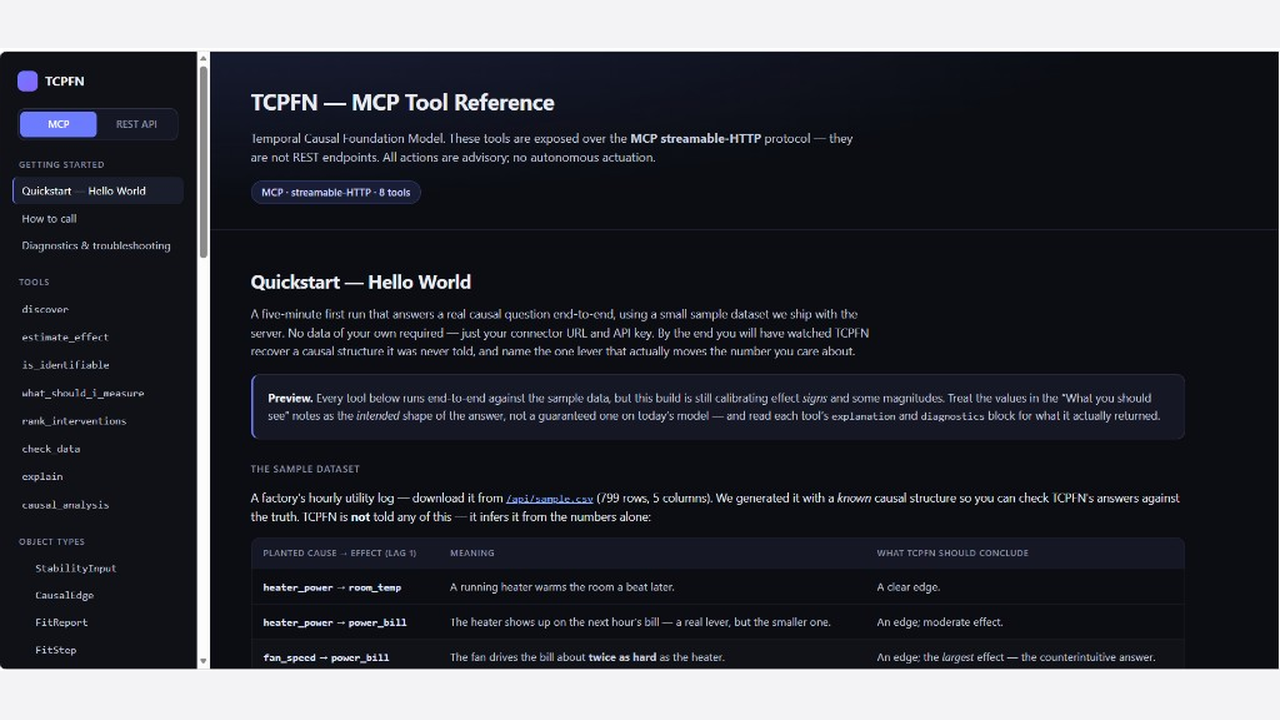
Agent build and provenance
See the full provenance
The layer-by-layer build, the evidence behind each claim, the risk basis and the cross-marketplace links are open to any account. Some rows are disclosed, some the source leaves Unknown; a free account shows you which.
Compliance
- FedRAMPConfirmedNot listed90%, registry-checkedNo FedRAMP Marketplace entry matched this vendor's domain, checked 2026-08-27registry recordas observed 2026-08-27
Confirmed means matched to a public authoritative registry. Claimed means the vendor or its listing states it, not yet cross-checked. A framework not shown was not found in any source we hold, which is not evidence against it. Not listed means a scoped registry check found no match for this vendor's domain: a No is a scoped registry check, not a compliance judgment. Confidence bands: 95% domain-verified, 90% registry-checked, 80% self-attested, 70% weak signal. Self-attested items marked “vendor's site” are gathered from the vendor's own website and are not verified by us.
Plans and pricing as listed
1 listedSources
Publisher resources
1 linkLinked repositories
Unknown means this listing does not publish a repository. It is not a statement that the code is closed, and a linked repository is not a claim that the publisher wrote it: the registry computes that relationship privately and does not publish it.
Evidence risk is the share of the build you cannot see before you deploy, not a security rating. Sign in to see the layer-by-layer basis for this band.