

UST SmartOps AI Correlation - AIOps Alert Consolidation
UST · Cybersecurity & IT
Certification per AWS Marketplace.
Evidence tier Source Confirmed · 4 captures on record
What the publisher says
As described on AWS Marketplace.
## UST SmartOps AI Correlation - Turn a Thousand Alerts Into One Incident
When a single failure - a database outage, a network partition, a bad deployment - cascades through an environment, dozens of monitoring tools each raise their own alert for the same underlying problem. UST SmartOps AI Correlation ingests events from every connected source, applies topology mapping, temporal clustering, and similarity models to group related signals into a single incident, and surfaces the event most likely to be the root cause.
Show the rest of the publisher’s description (31 more lines)
Responders get one incident with full context and a ranked list of contributing symptoms, instead of dozens of disconnected tickets they would otherwise have to manually stitch together.
## How It Works With AWS Services
This professional services engagement leverages specific AWS services to deliver intelligent alert correlation:
- **Amazon CloudWatch** - Ingests metrics, logs, and alarms from your AWS infrastructure as primary event sources for correlation analysis
- **AWS Health** - Consumes AWS Health events and service notifications to correlate platform-level issues with application symptoms
- **AWS CloudTrail** - Integrates change and API activity data to identify deployment or configuration changes as potential root causes
- **Amazon EventBridge** - Used as an event bus for routing correlated incidents and triggering downstream automation workflows
The solution also integrates with third-party monitoring and APM tools commonly deployed alongside AWS workloads, including Datadog, PagerDuty, Splunk, ServiceNow, and other ITSM platforms to provide true multi-source correlation across your entire observability stack.
## Key Features
- Multi-source correlation across AWS-native monitoring, third-party APM, and infrastructure tools
- Topology- and dependency-aware clustering that maps AWS resource relationships
- Time-window and similarity-based grouping with configurable correlation windows per environment
- Automatic root-cause candidate ranking within each cluster
- Feeds enriched incidents into downstream UST SmartOps modules (SmartResolution, SmartRoute)
## Key Benefits
- Reduce alert noise by consolidating hundreds of related alerts into single actionable incidents
- Faster root-cause identification leading to lower mean time to resolution (MTTR)
- Less manual alert triage and cross-referencing across monitoring tools
- Clear child-alert-to-parent-incident traceability for reporting and audit
- Improved accuracy of downstream automation and routing
## Engagement Model
This professional services engagement follows a structured delivery approach:
**Phase 1 - Discovery and Scoping (Week 1-2):** Assessment of your current monitoring landscape, identification of connected AWS services and third-party tools, and definition of correlation rules and thresholds tailored to your environment.
**Phase 2 - Integration and Configuration (Week 3-5):** Connection of event sources including Amazon CloudWatch, AWS Health, and third-party monitoring tools. Configuration of topology maps, correlation windows, and clustering parameters.
**Phase 3 - Tuning and Validation (Week 6-7):** Iterative refinement of correlation accuracy using historical alert data. Validation of root-cause ranking against known incidents.
**Phase 4 - Knowledge Transfer and Handover (Week 8):** Delivery of configured correlation rules, operational runbook, and training for your operations team.
**Deliverables:** Configured AI Correlation environment, integration with identified event sources, documented correlation rules, operational runbook, and knowledge transfer sessions.
## Use Cases
- **Retail platform during peak traffic:** A retailer running microservices on AWS experiences a cascading failure during a sales event. Hundreds of CloudWatch alarms, Datadog alerts, and PagerDuty notifications fire simultaneously. AI Correlation groups them into one incident and identifies the underlying RDS connection pool exhaustion as the root cause.
- **Financial services with multi-region monitoring:** A firm operating across multiple AWS regions receives duplicate alerts from regional monitoring tools for a single network partition. Correlation eliminates redundant incident creation and provides a unified view.
- **Enterprise microservice architectures:** Application-layer symptoms from APM tools are linked to infrastructure root causes surfaced by CloudWatch and AWS Health, reducing triage time from hours to minutes.
Highlights
Highlighted by the publisher on AWS Marketplace.
Correlates alerts across Amazon CloudWatch, APM, infrastructure, and third-party monitoring tools into a single parent incident using topology-aware clustering, temporal analysis, and pattern-similarity models. Unlike generic correlation engines, AI Correlation integrates natively with the broader SmartOps suite (SmartResolution, SmartRoute) to enable closed-loop automation from detection through remediation.
Structured professional services engagement with defined phases: discovery and scoping, implementation and integration, tuning and validation, and handoff with deliverables including configured correlation rules, integration runbooks, and knowledge-transfer sessions for your operations team.
Reduces mean time to resolution (MTTR) by consolidating alert storms into actionable incidents with ranked root-cause candidates. Responders see one incident with full context instead of manually triaging dozens of disconnected tickets across tools, layers, and teams during major outages.
Preview
1 image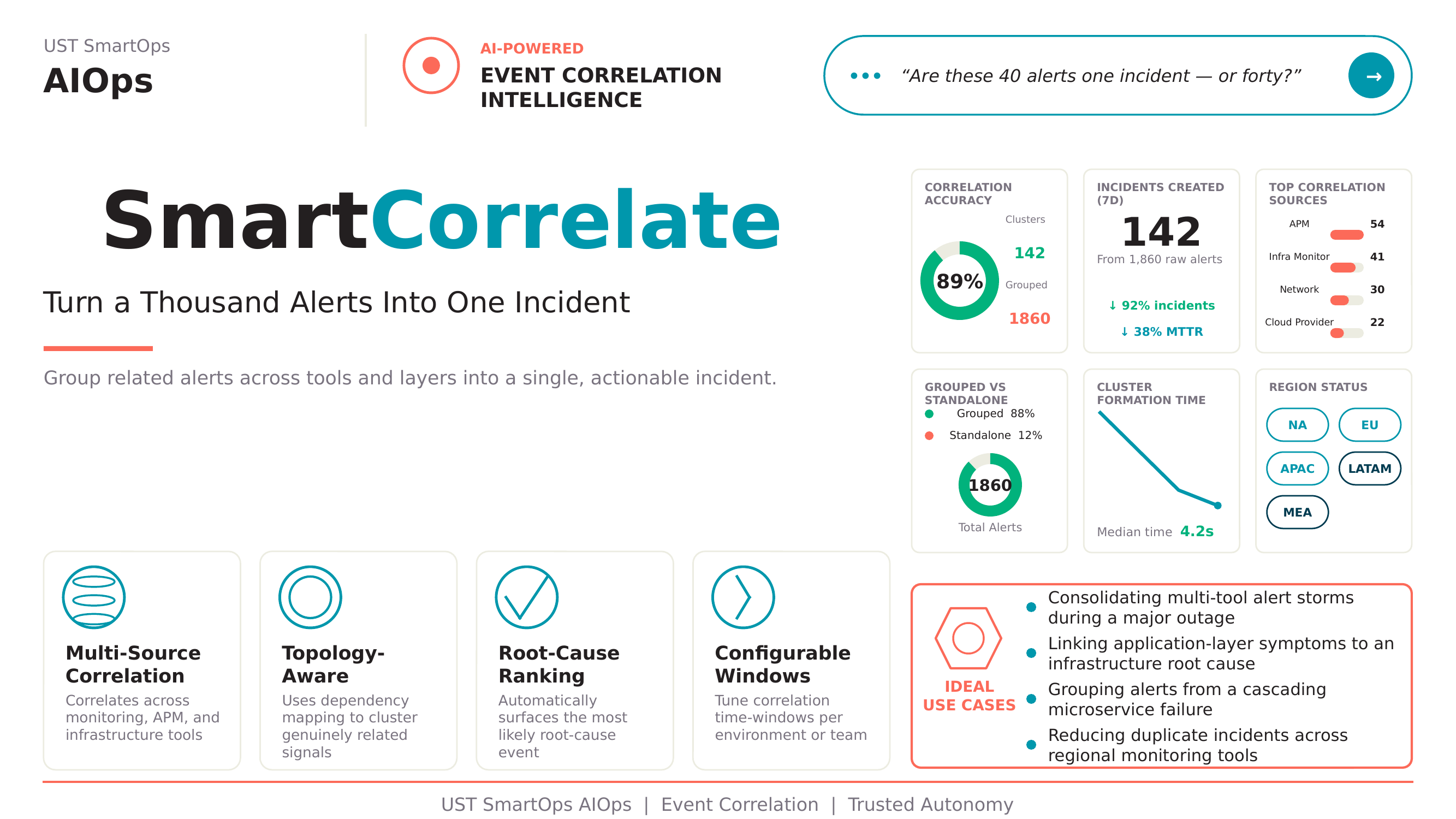
Agent build and provenance
See the full provenance
The layer-by-layer build, the evidence behind each claim, the risk basis and the cross-marketplace links are open to any account. Some rows are disclosed, some the source leaves Unknown; a free account shows you which.
Compliance
- FedRAMPConfirmedNot listed90%, registry-checkedNo FedRAMP Marketplace entry matched this vendor's domain, checked 2026-08-27registry recordas observed 2026-08-27
Confirmed means matched to a public authoritative registry. Claimed means the vendor or its listing states it, not yet cross-checked. A framework not shown was not found in any source we hold, which is not evidence against it. Not listed means a scoped registry check found no match for this vendor's domain: a No is a scoped registry check, not a compliance judgment. Confidence bands: 95% domain-verified, 90% registry-checked, 80% self-attested, 70% weak signal. Self-attested items marked “vendor's site” are gathered from the vendor's own website and are not verified by us.
Vendor
External enrichment · as of 2026-08-29
Sources
Linked repositories
Unknown means this listing does not publish a repository. It is not a statement that the code is closed, and a linked repository is not a claim that the publisher wrote it: the registry computes that relationship privately and does not publish it.
Evidence risk is the share of the build you cannot see before you deploy, not a security rating. Sign in to see the layer-by-layer basis for this band.