
UST SmartOps CapacityIQ - Autonomous Network Capacity Management
UST · Cybersecurity & IT
Certification per AWS Marketplace.
Evidence tier Source Confirmed · 4 captures on record
What the publisher says
As described on AWS Marketplace.
## UST SmartOps CapacityIQ - Autonomous Capacity Management
CapacityIQ continuously analyzes traffic trends across your network to forecast where and when capacity constraints will occur, then automatically triggers provisioning actions to stay ahead of demand. Built on UST SmartOps' closed-loop automation framework with agentic AI and policy-aware decision-making, CapacityIQ removes the guesswork and lag time from traditional, manual capacity-planning cycles.
Show the rest of the publisher’s description (32 more lines)
By right-sizing capacity to actual and forecasted demand - rather than static, over-provisioned baselines - CapacityIQ prevents congestion-driven service degradation while keeping infrastructure spend efficient and predictable.
## What Makes CapacityIQ Different
Unlike conventional capacity tools that only alert on thresholds, CapacityIQ employs closed-loop automation that transforms predictive insights into autonomous provisioning actions. The platform combines agentic AI for intelligent decision-making, policy-aware controls for governance compliance, and human-in-the-loop oversight for critical actions - ensuring optimized network performance with measurable ROI.
## Key Features
- Predictive traffic and demand forecasting with site-level granularity
- Automated capacity provisioning and scaling via closed-loop automation
- Site-level capacity risk ranking and proactive alerts
- Congestion-prevention monitoring across the entire estate
- Forecast-accuracy and cost-efficiency reporting dashboards
## Key Benefits
- Reduces congestion incidents by up to 52%
- Lowers infrastructure cost by up to 18% through right-sizing
- Prevents customer-facing degradation before it happens
- Removes manual effort from capacity-planning cycles
- Supports data-driven budget and CAPEX planning
## AWS Integration
CapacityIQ integrates natively with key AWS services to deliver end-to-end autonomous capacity management:
- **Amazon CloudWatch and AWS X-Ray** for real-time monitoring, observability, and telemetry ingestion
- **AWS Auto Scaling and Amazon EC2** for automated compute provisioning and resource scaling
- **AWS Lambda** for event-driven automation and orchestration of provisioning workflows
## Use Cases
- **Mobile operators managing large cell-site estates:** Forecast capacity needs weeks ahead across thousands of sites, automatically scaling resources before subscriber growth triggers congestion.
- **ISPs and fixed-network providers:** Auto-scale resource pools ahead of demand surges, preventing degradation during peak usage periods.
- **High-growth site management:** Identify and prioritize sites with accelerating demand curves for proactive capacity investment.
- **CAPEX planning for network teams:** Use forecast-driven analytics to support data-driven budget allocation and infrastructure investment decisions.
## Prerequisites and Scope
- Network telemetry data sources (traffic counters, utilization metrics) must be accessible
- Buyer provides API access or data feeds for capacity-relevant network elements
- Engagement covers deployment, configuration, and optimization handoff
- Minimum network scope applies; contact UST for sizing guidance
## Next Step
Request a discovery call to receive a complimentary network demand assessment and learn how CapacityIQ can be tailored to your environment.
Highlights
Highlighted by the publisher on AWS Marketplace.
CapacityIQ uses closed-loop automation with agentic AI and policy-aware decision-making to forecast network demand weeks ahead and auto-provision capacity without manual intervention. Unlike threshold-based alerting tools, it transforms predictive insights into autonomous actions with human-in-the-loop governance for critical decisions, delivering measurable ROI through intelligent, continuous optimization of network resources.
Reduces congestion incidents by up to 52% and lowers infrastructure cost by up to 18% through demand-driven right-sizing. The platform continuously monitors capacity risk across your entire network estate, ranking sites by growth trajectory and automatically scaling resources before customers experience degradation - replacing reactive, over-provisioned baselines with efficient, forecast-driven capacity allocation.
Structured engagement delivered in three phases: Discovery and Assessment (network demand baseline report), Implementation and Integration (configured platform with validated provisioning policies), and Optimization and Handoff (accuracy review, runbooks, and team enablement). The engagement typically spans 12 weeks, with clear deliverables at each milestone and defined prerequisites including network telemetry access and API connectivity.
Preview
1 image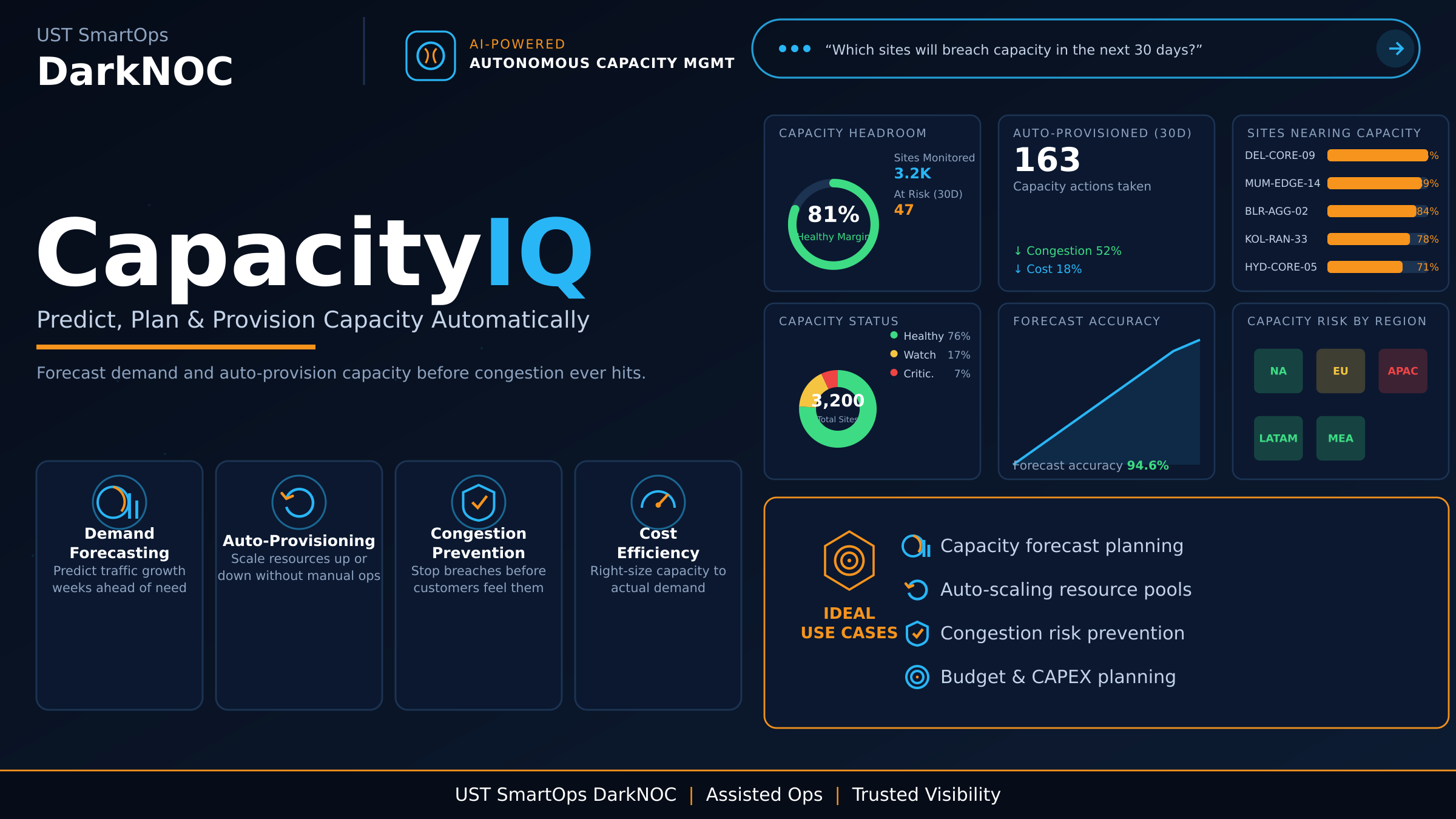
Agent build and provenance
See the full provenance
The layer-by-layer build, the evidence behind each claim, the risk basis and the cross-marketplace links are open to any account. Some rows are disclosed, some the source leaves Unknown; a free account shows you which.
Compliance
- FedRAMPConfirmedNot listed90%, registry-checkedNo FedRAMP Marketplace entry matched this vendor's domain, checked 2026-08-27registry recordas observed 2026-08-27
Confirmed means matched to a public authoritative registry. Claimed means the vendor or its listing states it, not yet cross-checked. A framework not shown was not found in any source we hold, which is not evidence against it. Not listed means a scoped registry check found no match for this vendor's domain: a No is a scoped registry check, not a compliance judgment. Confidence bands: 95% domain-verified, 90% registry-checked, 80% self-attested, 70% weak signal. Self-attested items marked “vendor's site” are gathered from the vendor's own website and are not verified by us.
Vendor
External enrichment · as of 2026-08-29
Sources
Linked repositories
Unknown means this listing does not publish a repository. It is not a statement that the code is closed, and a linked repository is not a claim that the publisher wrote it: the registry computes that relationship privately and does not publish it.
Evidence risk is the share of the build you cannot see before you deploy, not a security rating. Sign in to see the layer-by-layer basis for this band.