

UST SmartOps SmartResolution - Agentic AI Auto-Remediation
UST · Cybersecurity & IT
Certification per AWS Marketplace.
Evidence tier Source Confirmed · 3 captures on record
What the publisher says
As described on AWS Marketplace.
## Reduce MTTR and Eliminate Manual Remediation with Agentic AI
UST SmartOps SmartResolution is a professional services engagement that deploys a fully agentic, multi-agent AI remediation engine into your AWS environment. It auto-resolves recurring infrastructure incidents from detection to closed ticket - keeping humans in control only when genuine uncertainty exists.
Show the rest of the publisher’s description (47 more lines)
---
## How It Works: The Six-Stage Loop
- **Observe:** SmartOps Pulse monitors your Kubernetes clusters and cloud infrastructure for anomalies.
- **Parse:** A detected anomaly is structured into an AIOps alert.
- **Ticket:** A ticket is opened and bidirectionally synced to your ITSM platform.
- **Analyze:** The Prompt Agent extracts intent; the Supervisor Agent orchestrates the Knowledge Base Agent (tree-structured RAG retrieval) to match the issue against known SOPs and score confidence.
- **Act or Escalate:** When confidence exceeds your configured threshold, the Tool Calling Agent executes remediation via the Action Dispatcher and auto-closes the ticket. When confidence falls short, the Reviewer Agent routes the case to a human approver with full context.
- **Log:** Every decision - automated or human-approved - is recorded for audit.
---
## Key Features
- Supervisor Agent orchestration across specialist agents (Prompt, Knowledge Base, Reviewer, Tool Calling)
- Tree-structured knowledge base with RAG-based SOP matching
- Configurable confidence threshold gating automation vs. human-in-the-loop (HITL)
- Durable, ordered async queue (Action Dispatcher) for reliable execution
- Native bidirectional sync with ITSM and AIOps ticketing
- Full audit trail of every agent decision and human approval
---
## Key Benefits
- **Eliminates manual remediation** for recurring issues, freeing SRE and ops teams
- **Cuts mean time to resolution (MTTR)** by removing human wait-time from the resolution path
- **Keeps humans in control** of genuinely uncertain or high-risk incidents
- **Consistent, repeatable resolution** with no tribal-knowledge dependency
- **Scales incident response** without adding operations headcount
---
## Use Cases
- **Kubernetes auto-remediation:** Pod OOMKill detected, memory limit patched, deployment rolled, ticket closed - all without human intervention across clusters running hundreds of microservices on Amazon EKS.
- **Access-restoration workflows:** Password resets and permission grants executed with full audit trail, integrated with your identity provider.
- **Recurring service issues:** Documented SOPs applied automatically for known failure patterns (disk pressure, certificate expiry, scaling events).
- **Intelligent escalation:** Only genuinely ambiguous or high-risk cases reach human reviewers, with complete context attached.
---
## Engagement Overview
**Phase 1 - Discovery and Scoping (Weeks 1-2):** Environment assessment, ITSM integration mapping, identification of high-frequency incident categories suitable for automation.
**Phase 2 - Configuration and Pilot (Weeks 3-6):** Knowledge base population with your SOPs, confidence-threshold tuning, Action Dispatcher integration, pilot deployment on a subset of workloads.
**Phase 3 - Production Rollout (Weeks 7-10):** Full deployment, HITL workflow activation, team training, and handoff of configured system.
**Deliverables:** Configured knowledge base, integrated ITSM sync, tuned confidence thresholds, runbook library, and operational documentation.
---
## Prerequisites
- Kubernetes clusters (Amazon EKS recommended) or AWS cloud infrastructure
- Compatible ITSM platform (ServiceNow, Jira Service Management, or equivalent)
- Existing SOPs or runbooks for target incident categories
- Designated SRE or platform engineering liaison for the engagement
---
## AWS Integration
SmartResolution is built to operate natively within AWS environments, leveraging Amazon EKS, AWS Lambda, Amazon Bedrock for foundation model inference, and Amazon CloudWatch for observability signals.
---
## Next Step
Contact UST through AWS Marketplace Messaging to schedule a 30-minute discovery call and scope a pilot for your environment.
Highlights
Highlighted by the publisher on AWS Marketplace.
Fully agentic remediation - a Supervisor Agent orchestrates Prompt, Knowledge Base, Reviewer, and Tool Calling agents with no fixed script. Every decision is logged for audit, and the system adapts to your environment's SOPs through RAG-based retrieval against a tree-structured knowledge base. Operates natively on AWS with Amazon EKS, Amazon Bedrock, and CloudWatch integration.
Zero manual touch on the happy path - from anomaly detection through ITSM ticket creation to automated remediation and ticket closure. The Action Dispatcher uses a durable, ordered async queue to ensure reliable execution. Designed to handle recurring Kubernetes and cloud infrastructure incidents such as pod OOMKills, disk pressure, certificate expiry, and scaling events without human intervention.
Confidence-gated human-in-the-loop - a configurable threshold determines when the system acts autonomously versus when it routes to a human reviewer. Reviewers see full incident context and can approve or reject with a logged reason. Only genuinely uncertain or high-risk cases reach humans, keeping your team focused on novel problems rather than repetitive remediation tasks.
Preview
1 image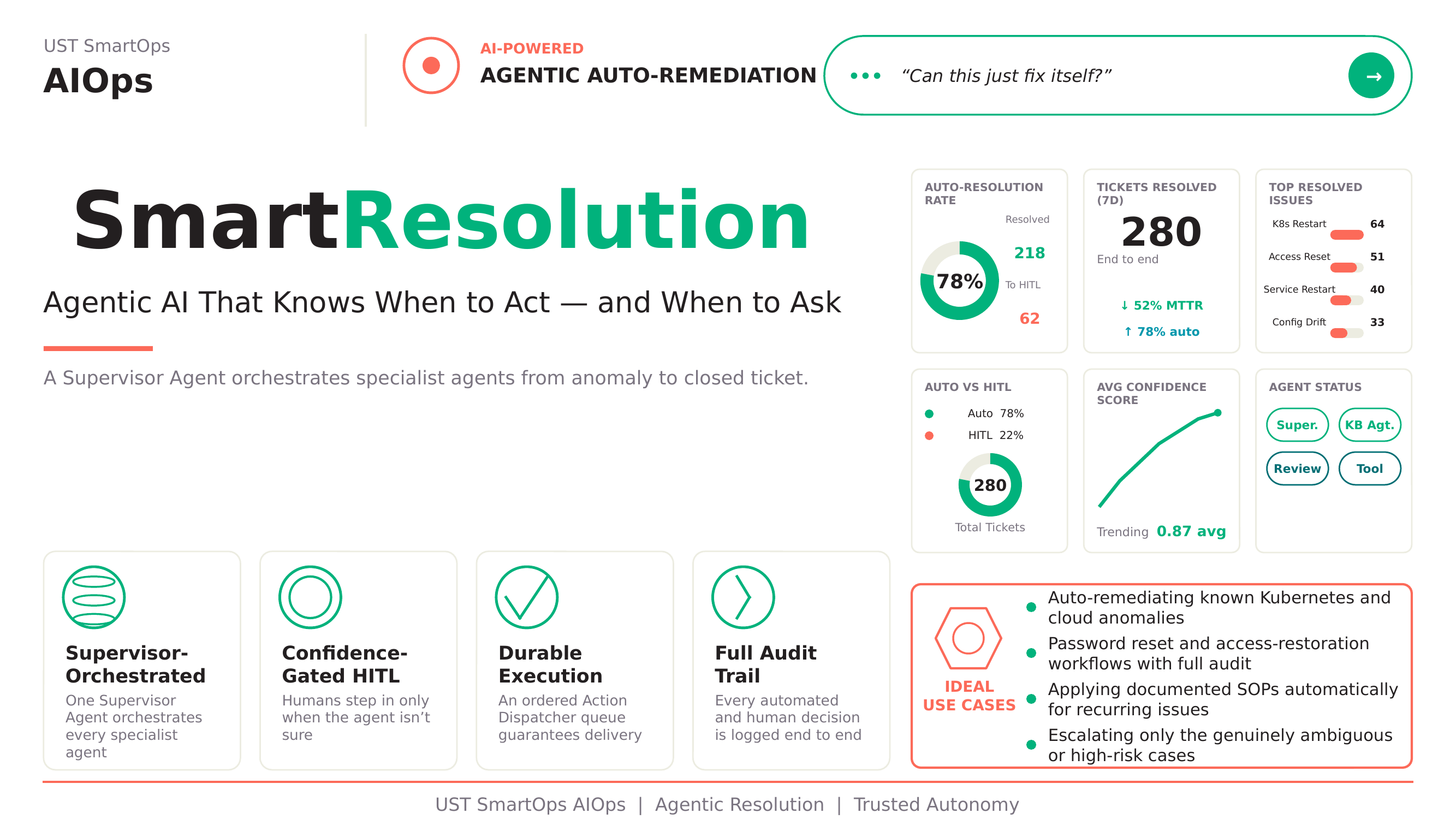
Agent build and provenance
See the full provenance
The layer-by-layer build, the evidence behind each claim, the risk basis and the cross-marketplace links are open to any account. Some rows are disclosed, some the source leaves Unknown; a free account shows you which.
Compliance
- FedRAMPConfirmedNot listed90%, registry-checkedNo FedRAMP Marketplace entry matched this vendor's domain, checked 2026-08-27registry recordas observed 2026-08-27
Confirmed means matched to a public authoritative registry. Claimed means the vendor or its listing states it, not yet cross-checked. A framework not shown was not found in any source we hold, which is not evidence against it. Not listed means a scoped registry check found no match for this vendor's domain: a No is a scoped registry check, not a compliance judgment. Confidence bands: 95% domain-verified, 90% registry-checked, 80% self-attested, 70% weak signal. Self-attested items marked “vendor's site” are gathered from the vendor's own website and are not verified by us.
Vendor
External enrichment · as of 2026-08-29
Sources
Linked repositories
Unknown means this listing does not publish a repository. It is not a statement that the code is closed, and a linked repository is not a claim that the publisher wrote it: the registry computes that relationship privately and does not publish it.
Evidence risk is the share of the build you cannot see before you deploy, not a security rating. Sign in to see the layer-by-layer basis for this band.