

AIR Dynamic Pricing by GK
GK Software SE · Intelligence & Research
Certification per Microsoft Marketplace.
Evidence tier Source Confirmed · 7 captures on record
What the publisher says
As described on Microsoft Marketplace.
Pricing is one of the
most effective turnovers and sales levers in retail; however, large
Show the rest of the publisher’s description (44 more lines)
product ranges and complex framework conditions make it virtually impossible
for category managers to guarantee an ideal number for each individual product.
Modern pricing tools such as AIR Dynamic Pricing by GK can automatically adapt
prices to both customer behavior and constantly changing market,
environmental and competitive situations.
AIR Dynamic Pricing automatically adjusts the prices of
thousands of SKUs, including product variants considering all relevant contextual
conditions daily. Streamlined updates of transaction and master data ensure
that price
elasticities and sales forecasts can be modeled in memory and on the SKU level. This is the basis
for permanent up-to-date predictions and a highly performant calculation of
optimized prices.
The main
challenge in price calculation is the product life cycle, especially regarding
the connected sales KPI targets. While finding optimal prices at the beginning of the life cycle is key,
the main two use cases for dynamic pricing lie at the high phase and the end of
the product life cycle:
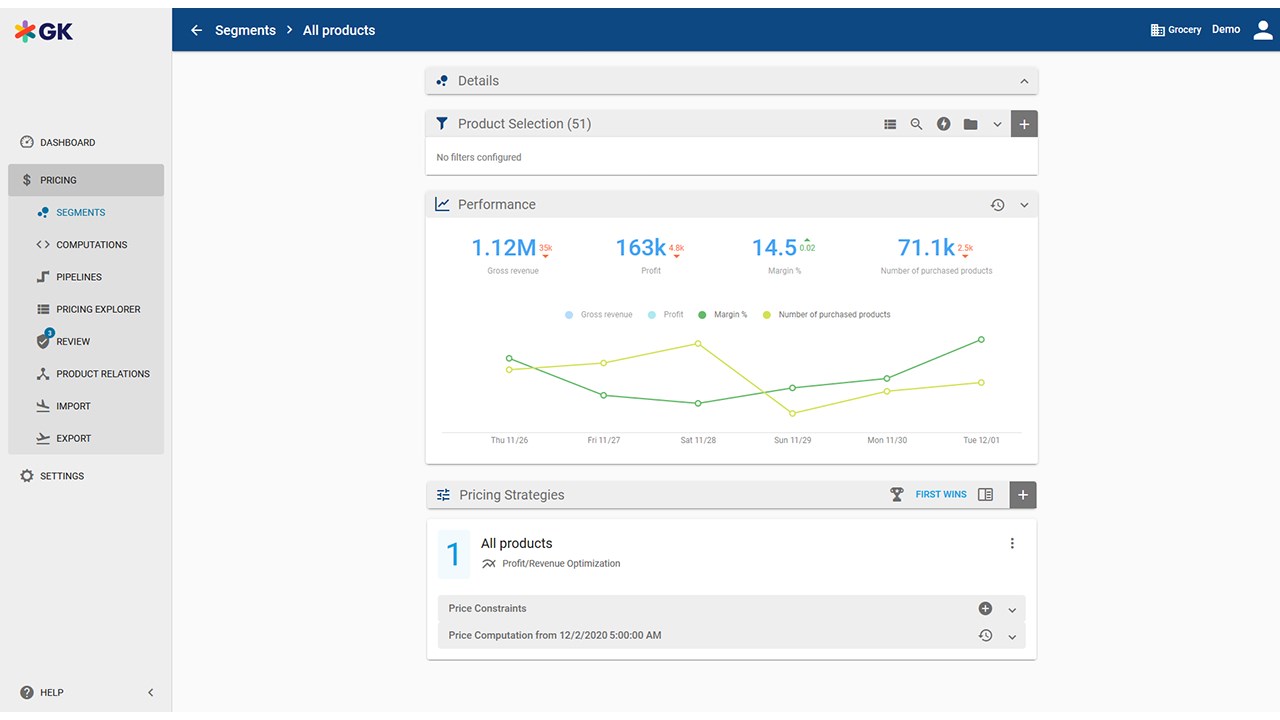
- Regular Pricing: During the high phase of the
product life cycle and never-out-of-stock items, the AI pricing algorithms
are optimized to increase margins and revenue. The weight of either of
these sales KPIs is controlled by category management via the web
interface. Demand-driven, the AI intelligently adjusts prices to reach the
specified (weighted) average targets across the different product ranges.
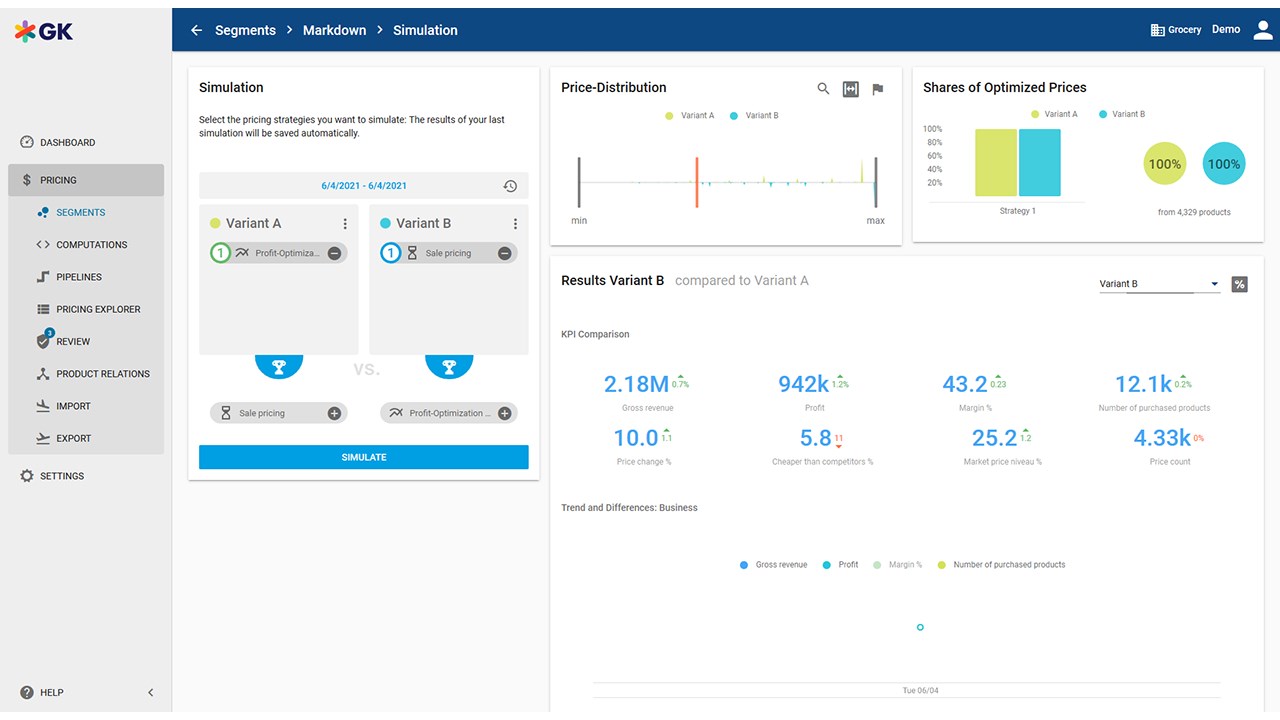
- Markdown Pricing: At the end of the product life
cycle, the goal of the AI markdown pricing algorithm is to reach zero
stock by a defined target date. For each item, the algorithm respects the
current demand and controls the sale via price. Considering the current
demand ensures preserving as much margin as possible while avoiding losses
resulting from not selling off in time.
The AI
solution combines given business rules and constraints with advanced machine
learning algorithms. Via an intuitive and user-friendly web interface, pricing
processes can be aligned across all sales channels and locations.
By
automating the pricing process, the workload of the category management is
significantly reduced. AIR
Dynamic Pricing automatically
calculates optimal prices for the entire product range. Nonetheless, category
management can review price recommendations in a half-automated workflow,
especially for customer-focus items such as KVIs. This workflow includes a
reasoning feature, allowing the user to understand the AI price
recommendations. Altogether this enables category management to invest its time
much more effectively by strategically controlling prices and thus achieving
defined target KPIs reliably.
Preview
3 images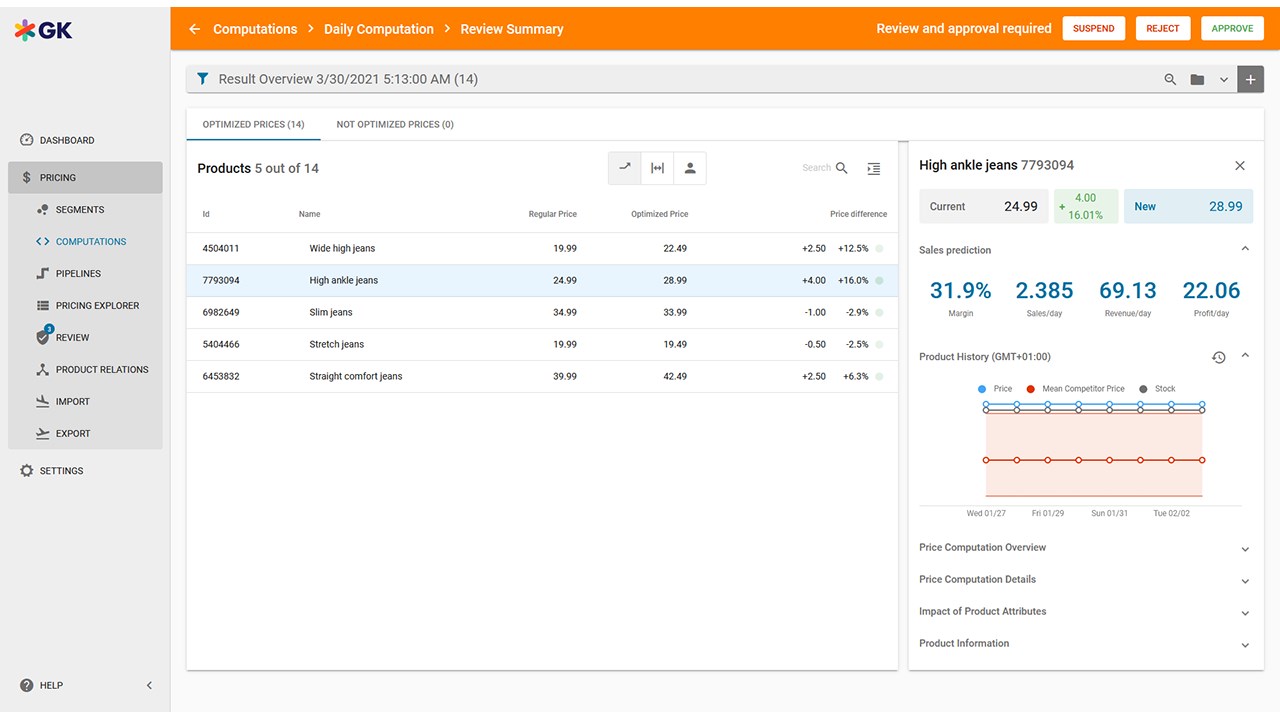
Agent build and provenance
See the full provenance
The layer-by-layer build, the evidence behind each claim, the risk basis and the cross-marketplace links are open to any account. Some rows are disclosed, some the source leaves Unknown; a free account shows you which.
Sources
Publisher resources
2 linksLinked repositories
Unknown means this listing does not publish a repository. It is not a statement that the code is closed, and a linked repository is not a claim that the publisher wrote it: the registry computes that relationship privately and does not publish it.
Evidence risk is the share of the build you cannot see before you deploy, not a security rating. Sign in to see the layer-by-layer basis for this band.