
XSI-AIMS Compass
Extended Systems Inc. · Operations & Productivity
Certification per Microsoft Marketplace.
Evidence tier Source Confirmed · 8 captures on record
What the publisher says
As described on Microsoft Marketplace.
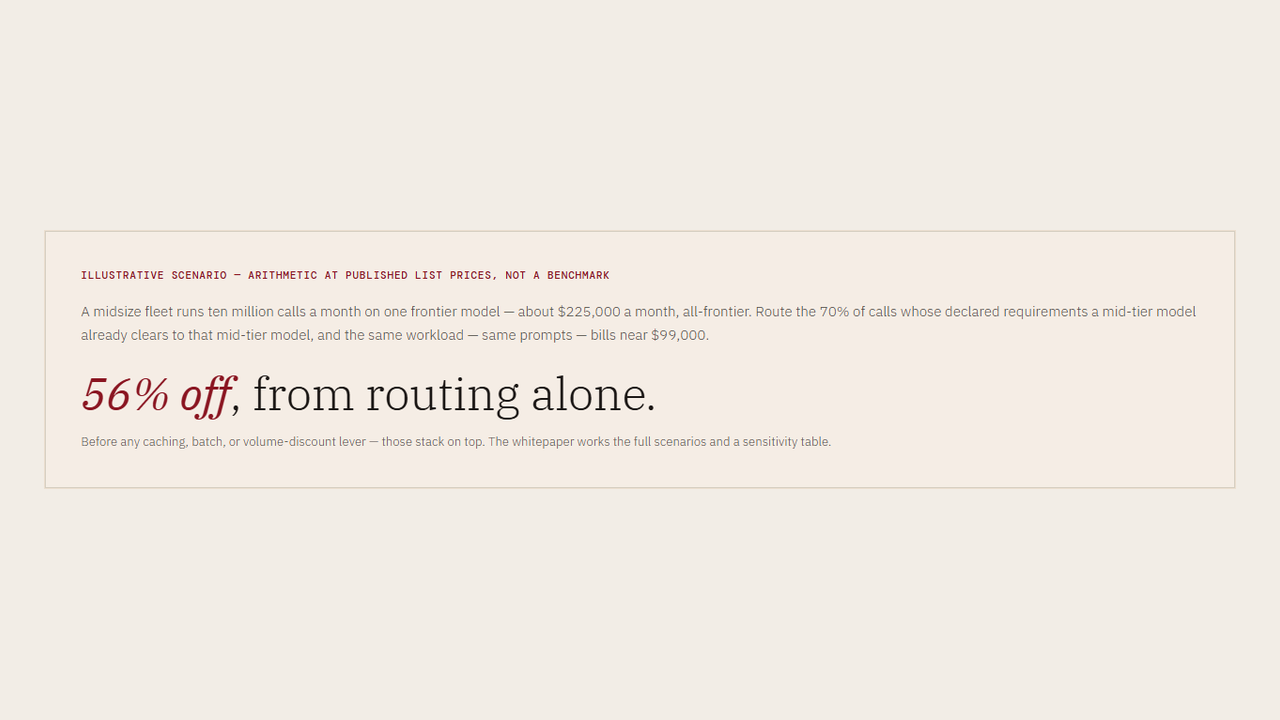
A single agent is a rounding error. A fleet is a budget line. The dominant pattern is one flagship model for every call — so a 40-token classification ping and a 150,000-token contract review ride the same top-of-spread rate. As of mid-2026, published input rates across the major vendors' current lineups span about 100x. Fleets buy frontier capability for calls that never declared a need for it.
XSI-AIMS Compass is the model router for the XSI-AIMS standard. Register your provider keys once; declare per-call requirements; Compass routes each call to the cheapest registered model that meets them.
Show the rest of the publisher’s description (15 more lines)
Three steps, one router
- Register — your provider keys: Azure OpenAI and other major providers, or locally-served models, anything that speaks a known protocol.
- Profile — Compass researches each model's cost-per-token, context window, tool-call support, JSON mode, and other capability dimensions.
- Route — at call time, Compass picks the cheapest registered model that meets the call's declared requirements.
What you can declare
Max cost per call, required tool / function support, latency budget, JSON mode, minimum context window, required modality, an adversarial-challenge round for safety-critical calls, and vendor exclusions or pinned-model overrides.
Two opinions for the important calls
For high-stakes outputs, Compass routes the call through a primary model and a second challenge model in parallel; disagreement surfaces to the agent before it commits. Use it when the cost of a wrong answer exceeds the cost of two inferences. Maps directly to the XSI-AIMS blind-spot monitoring principle. Every routing decision lands in the XSI-AIMS agent registry's audit log.
What routing does not solve
Routing cannot fix a bad prompt — a mis-specified call routes cheaply and fails cheaply. Savings depend entirely on workload mix: a fleet whose every call genuinely needs frontier reasoning has a routable share near zero. And the requirements taxonomy is engineering the customer owns — Compass routes on declarations. It sets the floor; it does not write the requirements.
Availability
XSI-AIMS Compass is a commercial XSI product implementing the open XSI-AIMS standard. Licensed by XSI, contact-gated — reach out and we onboard your team directly.
Part of XSI-AIMS
Read the standard at https://xtendedsystems.com/aims/ · on GitHub at https://github.com/Extended-Systems-Intelligence/aims · sibling instrument XSI-AIMS Atlas (memory routing) at https://xtendedsystems.com/aims/atlas/.
Stop paying the top of the spread. Contact me to start.
Preview
2 images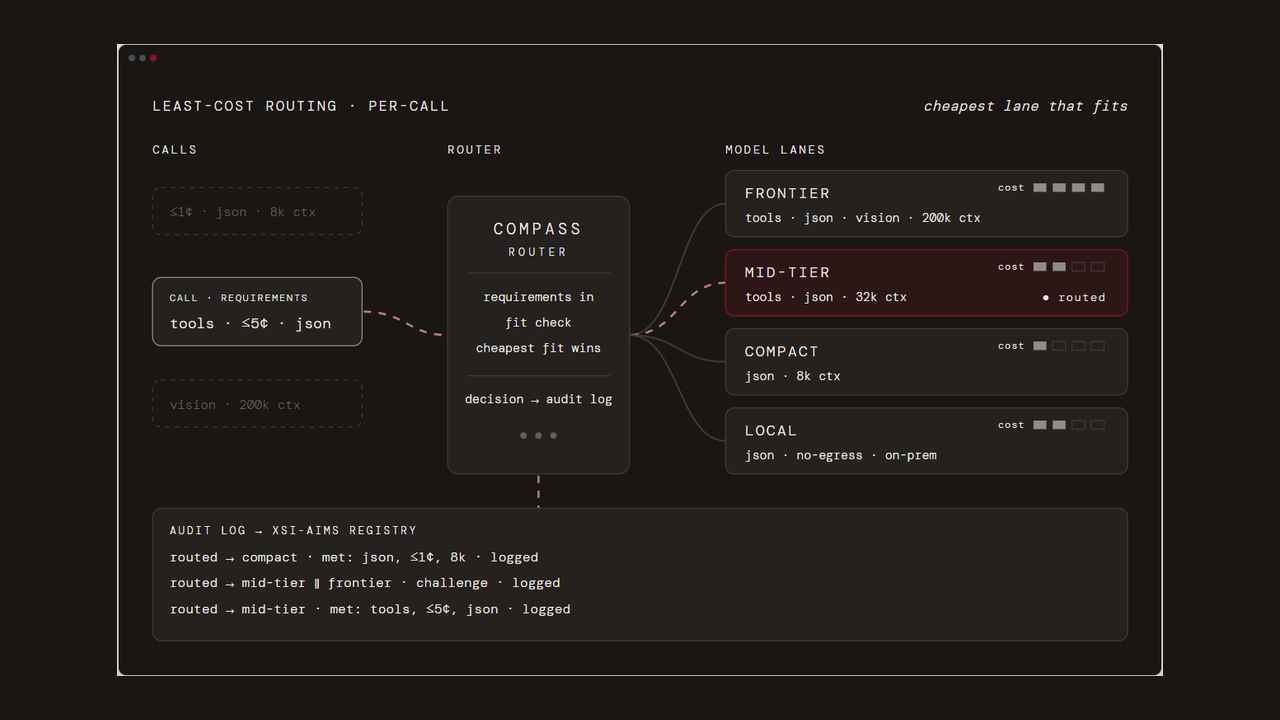
Agent build and provenance
See the full provenance
The layer-by-layer build, the evidence behind each claim, the risk basis and the cross-marketplace links are open to any account. Some rows are disclosed, some the source leaves Unknown; a free account shows you which.
Compliance
- FedRAMPConfirmedNot listed90%, registry-checkedNo FedRAMP Marketplace entry matched this vendor's domain, checked 2026-08-27registry recordas observed 2026-08-27
Confirmed means matched to a public authoritative registry. Claimed means the vendor or its listing states it, not yet cross-checked. A framework not shown was not found in any source we hold, which is not evidence against it. Not listed means a scoped registry check found no match for this vendor's domain: a No is a scoped registry check, not a compliance judgment. Confidence bands: 95% domain-verified, 90% registry-checked, 80% self-attested, 70% weak signal. Self-attested items marked “vendor's site” are gathered from the vendor's own website and are not verified by us.
Vendor
External enrichment
Sources
Publisher resources
2 linksLinked repositories
1 repoUnknown means this listing does not publish a repository. It is not a statement that the code is closed, and a linked repository is not a claim that the publisher wrote it: the registry computes that relationship privately and does not publish it.
Evidence risk is the share of the build you cannot see before you deploy, not a security rating. Sign in to see the layer-by-layer basis for this band.