

XSI-AIMS Atlas
Extended Systems Inc. · Operations & Productivity
Certification per Microsoft Marketplace.
Evidence tier Source Confirmed · 8 captures on record
What the publisher says
As described on Microsoft Marketplace.
At prototype scale, memory never gets asked the hard question — one vector store and a generous context window carry a single demo agent fine. At fleet scale it dominates. Put hundreds of agents in production, each making thousands of calls a day, and every call embeds a memory decision: what to read before acting, what to write after, where both should live.
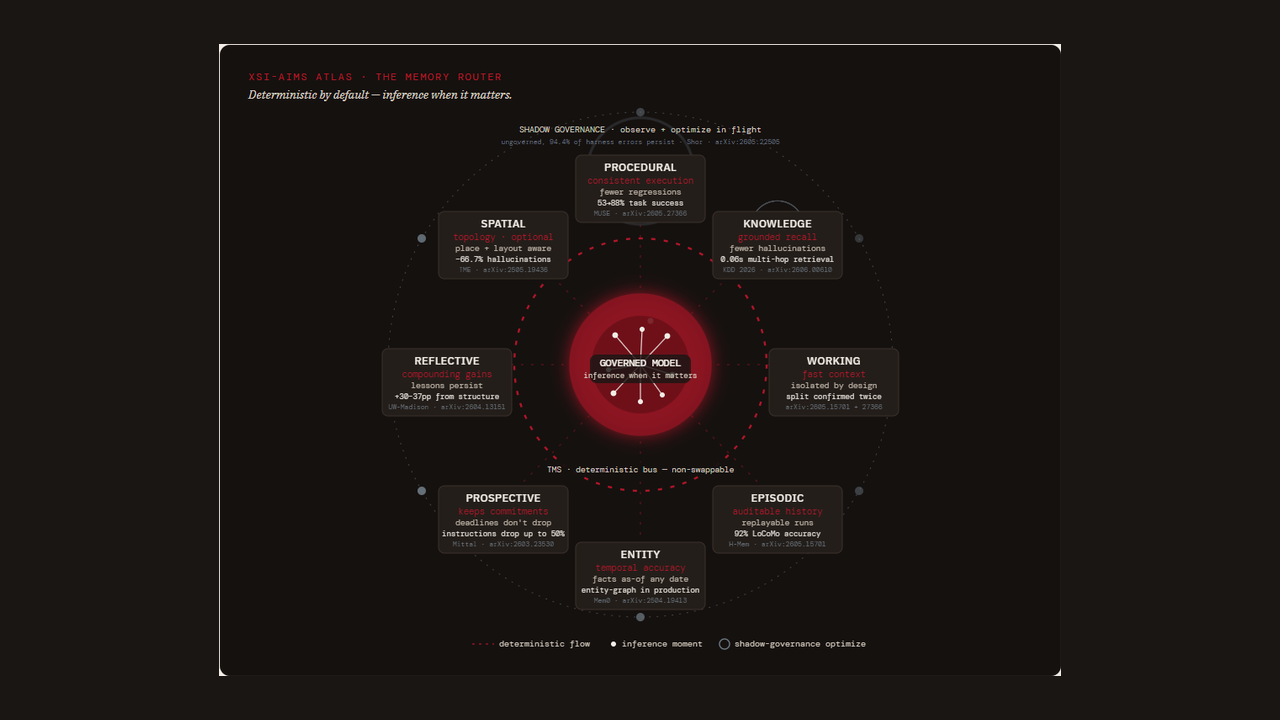
XSI-AIMS Atlas is the memory routing engine for the XSI-AIMS memory family. Agents call one interface; Atlas routes each call to the right subsystem and the right backend. Deterministic by default — inference only when it matters.
Show the rest of the publisher’s description (19 more lines)
Eight subsystems, one interface
XSI-AIMS recognizes seven core memory subsystems plus an optional spatial profile. Agents declare the kind of memory they need, not the database that holds it:
- Procedural — how the agent does what it does: skills, procedures, the workflow corpus.
- Knowledge — what the agent knows about: semantic knowledge, the retrieval surface.
- Working — what is in flight right now: per-invocation scratch, never cross-session indexed.
- Episodic — what happened: a raw event tier and a consolidated tier.
- Entity — entity facts over time: bi-temporal, queryable as-of any date.
- Prospective — future-directed intentions: triggers, reminders, commitments.
- Reflective — lessons learned, promoted into procedure through a governed gate.
- Spatial — locality, paths, regions: an optional profile for embodied domains.Each subsystem has a default backend and accepts drop-in alternatives at registration time. Spanning all of them is the Trust and Memory Provenance bus (TMS) — promotion, consolidation, and provenance through one governed contract. The bus is not swappable. That is the point.
Why routing
The default architecture is one store — one vector database, one similarity-ranked access pattern, every kind of memory forced through it. That pattern is right for exactly one job and wrong for everything else agents remember. Reliability, recall, consistency, and cost diverge subsystem by subsystem. Atlas routes each operation to a subsystem-appropriate store so the contract is declared, not improvised — and the same declaration routes to the same stores every time, so agents stay reproducible and incidents stay debuggable.
What it does not solve
Routing cannot repair a bad write — Atlas delivers the read and the write to the right contract, but does not validate that what the agent wrote was true. It does not fix prompts. And XSI has published no Atlas benchmarks; every performance figure XSI cites is an external result until Atlas numbers exist.
Availability
XSI-AIMS Atlas is a commercial XSI product implementing the open XSI-AIMS standard. Licensed by XSI, contact-gated — reach out and we onboard your team directly.
Part of XSI-AIMS
Read the standard at https://xtendedsystems.com/aims/ · on GitHub at https://github.com/Extended-Systems-Intelligence/aims · sibling instrument XSI-AIMS Compass (model routing) at https://xtendedsystems.com/aims/compass/.
Talk to us about memory at orchestration scale. Contact me to start.
Preview
2 images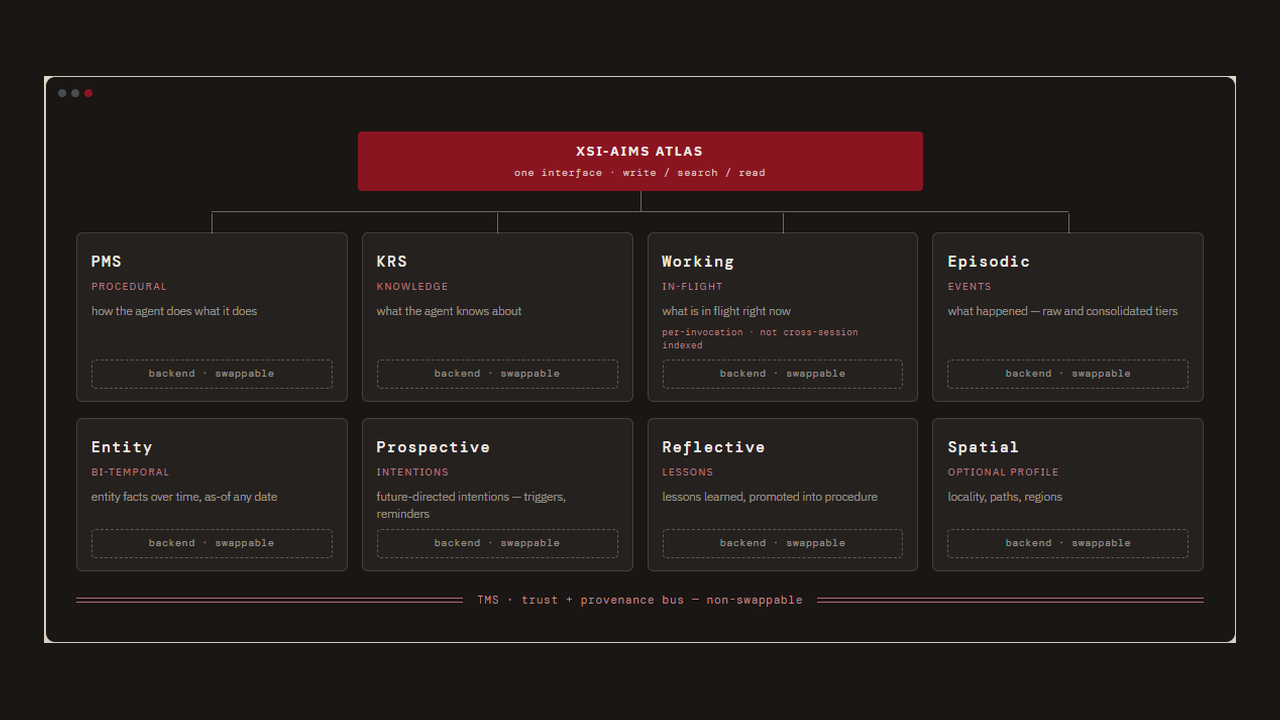
Agent build and provenance
See the full provenance
The layer-by-layer build, the evidence behind each claim, the risk basis and the cross-marketplace links are open to any account. Some rows are disclosed, some the source leaves Unknown; a free account shows you which.
Compliance
- FedRAMPConfirmedNot listed90%, registry-checkedNo FedRAMP Marketplace entry matched this vendor's domain, checked 2026-08-27registry recordas observed 2026-08-27
Confirmed means matched to a public authoritative registry. Claimed means the vendor or its listing states it, not yet cross-checked. A framework not shown was not found in any source we hold, which is not evidence against it. Not listed means a scoped registry check found no match for this vendor's domain: a No is a scoped registry check, not a compliance judgment. Confidence bands: 95% domain-verified, 90% registry-checked, 80% self-attested, 70% weak signal. Self-attested items marked “vendor's site” are gathered from the vendor's own website and are not verified by us.
Vendor
External enrichment
Sources
Publisher resources
3 linksLinked repositories
1 repoUnknown means this listing does not publish a repository. It is not a statement that the code is closed, and a linked repository is not a claim that the publisher wrote it: the registry computes that relationship privately and does not publish it.
Evidence risk is the share of the build you cannot see before you deploy, not a security rating. Sign in to see the layer-by-layer basis for this band.