

Evidence tier Source Confirmed · 8 captures on record
What the publisher says
As described on Microsoft Marketplace.
Ei-Flow
Neuro-Symbolic Orchestration Platform for Enterprise AI
Show the rest of the publisher’s description (34 more lines)
Introduction
Ei-Flow is the orchestration foundation of Expert.ai’s neuro-symbolic approach. It enables enterprises to build, deploy, and govern AI-driven workflows that combine LLMs, semantic reasoning, HybridRAG retrieval, and business rules in a unified platform. Rather than relying on isolated prompts or ad-hoc scripts, Ei-Flow structures AI into repeatable, auditable, and scalable processes that can integrate with enterprise systems.
The platform acts as the “conductor” of the AI ecosystem: it connects models, data sources, knowledge graphs, and downstream applications, ensuring that outputs are grounded in enterprise knowledge and aligned with governance, cost control, and compliance requirements. This makes Ei-Flow particularly suited for regulated, knowledge-intensive sectors—banking, insurance, government, manufacturing, energy, utilities, and telecommunications—where AI must be explainable and reliable, not experimental.
Platform Overview
Ei-Flow provides a visual and low-code environment for designing and executing workflows. Users create flows as sequences of blocks representing tasks such as ingestion, retrieval, enrichment, validation, or system integration. The underlying runtime engine supports sequential and parallel execution, asynchronous operations, error recovery, and human-in-the-loop steps.
What differentiates Ei-Flow is its agent-based architecture. Agents encapsulate domain logic or operational responsibility—retrieving information, classifying content, enforcing rules, or interacting with external APIs. They can collaborate, delegate tasks, or validate results. Agents are reusable across flows, allowing companies to scale quickly by building libraries of domain-specific components rather than starting from scratch every time.
Core Functional Capabilities
- Visual workflow designer
- Low-code modeling of complex AI processes
- Parallel branches, conditional paths, retries, and compensation logic
- Agent layer
- Reusable, configurable agents with defined roles/goals
- Collaboration and task delegation between agents
- Multi-model orchestration
- LLMs, expert semantic engines, domain models
- Ability to select the optimal model per task (cost/performance)
- HybridRAG integration
- Retrieval from documents, vectors, and knowledge graphs
- Reduced hallucinations through grounded context
- External system connectors
- REST, databases, document repositories, n8n, Power Automate
- Governance & observability
- Versioning, logging, cost monitoring, explainability, and auditing
- Security & deployment
- SaaS multi-tenant, dedicated tenant, or hybrid modelsHow Ei-Flow Works
A typical workflow in Ei-Flow begins with defining triggers and data sources: a document upload, an email, an API call, or a scheduled event. The flow then applies ingestion and preprocessing (OCR, splitting, classification), retrieves knowledge using HybridRAG, and orchestrates neural and symbolic reasoning through agents. Semantic extraction and rule validation ensure consistency and reduce model drift, while human review steps can be inserted for high-impact decisions.
Outputs can be delivered as structured data, recommendations, alerts, or natural-language responses. The flow can integrate with CRMs, ERPs, ticketing systems, or be exposed as a REST service or Teams bot. Throughout execution, Ei-Flow logs metrics and token consumption, captures prompts and decisions, and records provenance for compliance.
End-to-End Lifecycle
- Design flows and agents using the visual canvas
- Onboard knowledge via HybridRAG indexing and semantic enrichment
- Execute workflows with monitoring, retry strategy, and branching logic
- Validate and explain decisions using rules, citations, and logs
- Deploy and integrate with enterprise systems and automation tools
- Optimize and govern using metrics, costs, and versioning
Preview
1 image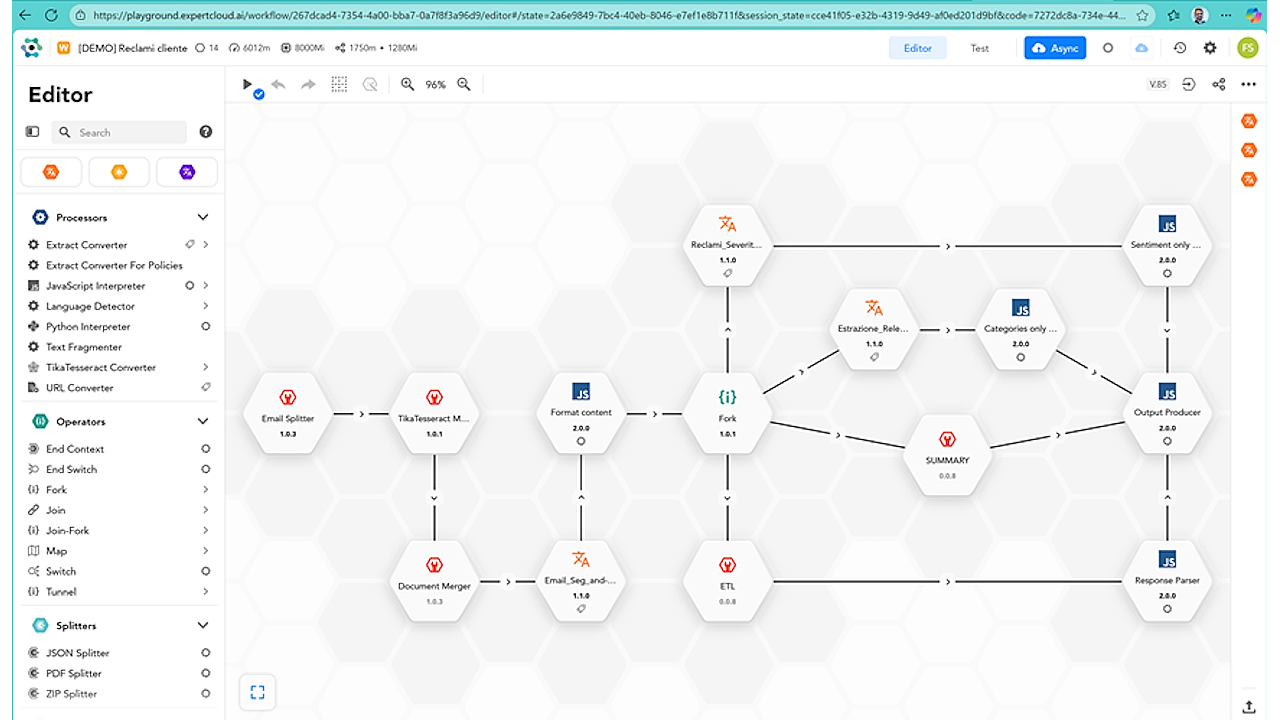
Agent build and provenance
See the full provenance
The layer-by-layer build, the evidence behind each claim, the risk basis and the cross-marketplace links are open to any account. Some rows are disclosed, some the source leaves Unknown; a free account shows you which.
Compliance
- FedRAMPConfirmedNot listed90%, registry-checkedNo FedRAMP Marketplace entry matched this vendor's domain, checked 2026-08-27registry recordas observed 2026-08-27
Confirmed means matched to a public authoritative registry. Claimed means the vendor or its listing states it, not yet cross-checked. A framework not shown was not found in any source we hold, which is not evidence against it. Not listed means a scoped registry check found no match for this vendor's domain: a No is a scoped registry check, not a compliance judgment. Confidence bands: 95% domain-verified, 90% registry-checked, 80% self-attested, 70% weak signal. Self-attested items marked “vendor's site” are gathered from the vendor's own website and are not verified by us.
Vendor
External enrichment · as of 2026-08-08
Plans and pricing as listed
1 listedSources
Publisher resources
1 linkLinked repositories
Unknown means this listing does not publish a repository. It is not a statement that the code is closed, and a linked repository is not a claim that the publisher wrote it: the registry computes that relationship privately and does not publish it.
Evidence risk is the share of the build you cannot see before you deploy, not a security rating. Sign in to see the layer-by-layer basis for this band.