

Public Transit Analytics In-Vehicle Passenger Information System - SaaS
Dace IT℠d/b/a Sense Traffic Pulse™ · Intelligence & Research
Certification per Microsoft Marketplace.
Evidence tier Source Confirmed · 8 captures on record
What the publisher says
As described on Microsoft Marketplace.
IN-VEHICLE PASSENGER INFORMATION SYSTEM DEFINITIONS
IPIS –IN-VEHICLE PASSENGER INFORMATION SYSTEM
Show the rest of the publisher’s description (20 more lines)
Public Transit Analytics In-Vehicle Passenger Information System provides transportation officials a software subscription to analyze & plan in-bus ridership and route usage. This software as a service (SaaS) solution can be used with an in-vehicle display capable of relaying information
to riders while using deep learning models and computer vision to analyze & plan in-bus ridership and route usage.
Public Transit Analytics
This SaaS application empowers public and private transportation agency officials the ability to use Edge Insights for Fleet middleware and delivers deep learning models, computer vision algorithms on Microsoft technologies which integrates Azure and Azure AI/ML & Intel's OpenVINO software without the need for IT Staffing or Data Scientist being onboard. The application also temporarily stores relevant video images for validating the accuracy of detections.
How It Works
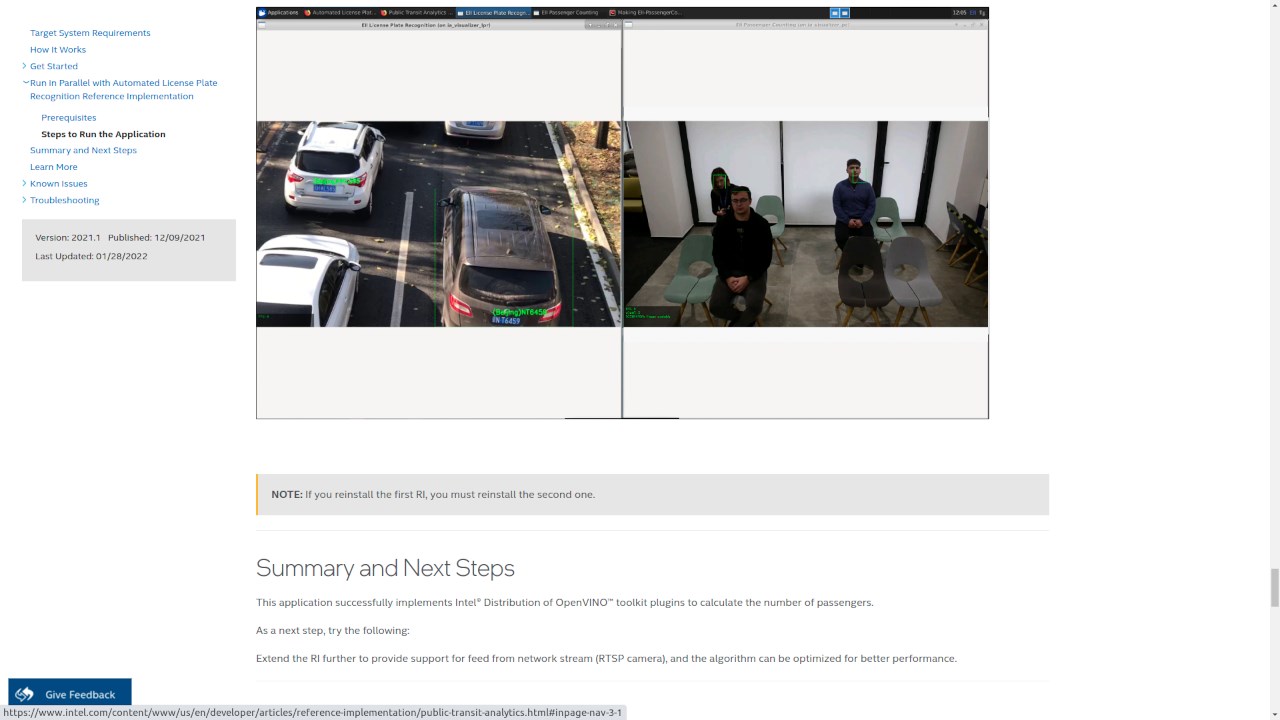
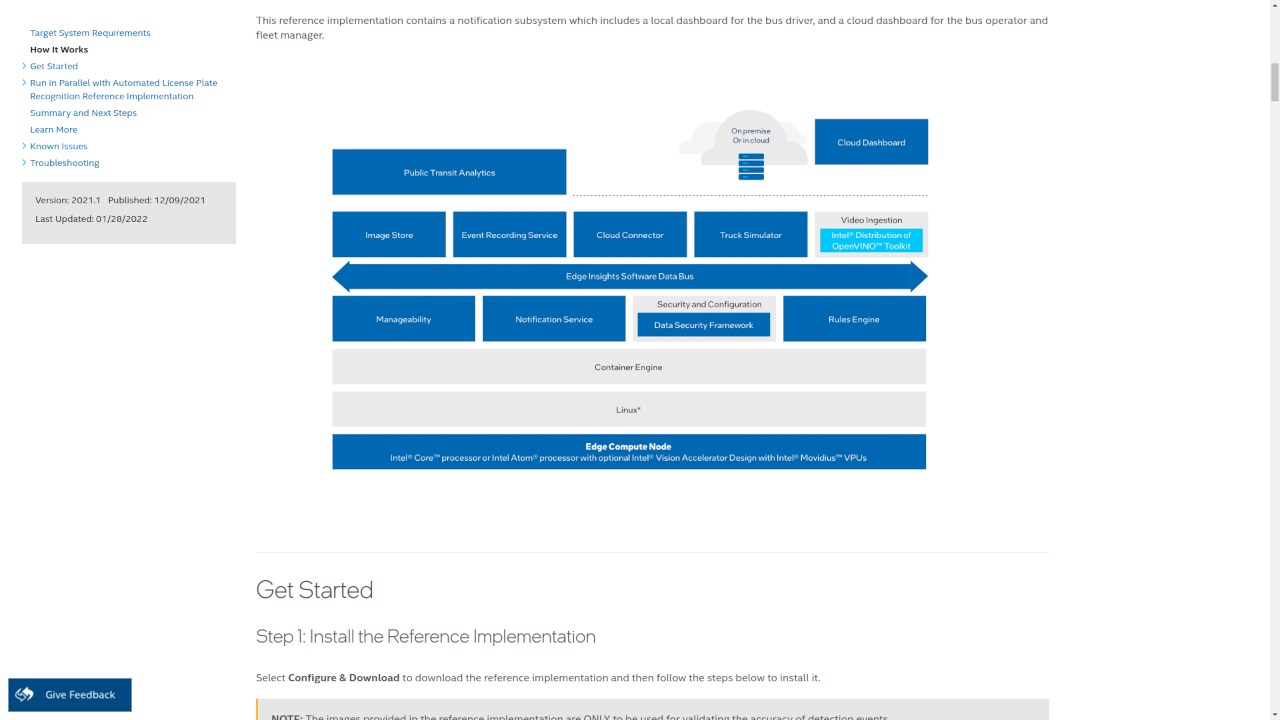
The Public Transit Analytics In-Vehicle Passenger Information System SaaS reference implementation contains a full pipeline of analytics on video streams from IP cameras mounted inside a bus in the passenger area streamed to hosted environment of Intel® Core™ or Intel Atom® processor-based computers where Pretrained Azure AI/ML & Intel's OpenVINO software models are used to inference and calculate the number of passengers. This In-Vehicle Passenger Information System contains a notification subsystem which can feed local dashboards for the bus driver, and a cloud dashboard for the bus operator and fleet manager.
Benefits
- AI/ML --Intel Edge Software Recipes based on OpenVINO Open Source
- CAD – Computer Aided Dispatch software used to assist with vehicle management
- AVL – Automatic Vehicle Location is a means for automatically determining and transmitting the geographic location of a vehicle.
- GTFS – General Transit Feed Specification defines a common format for public transportation schedules and associated geographic information.
- GTFS-RT – General Transit Feed Specification Real Time is a feed specification that allows public transportation agencies to provide real time updates about their fleet to application developers. Cloud-based – digital data stored, managed, and processed on a network of remote servers hosted on the internet, rather than on local servers or personal computers.The cost of running this product is by picking a software plan. Charges are billed by the Azure subscription tenant domain from which you will be running this software. Your Azure infrastructure price might vary if you have enterprise agreements or other discounts. Dace IT℠ with Sense Traffic Pulse™ offers rate plans that can work within your organization's budget to customize and extend implementation scenarios. Online and chat services are also available.
The In-Vehicle Passenger Information System platform is provided by a Certified Disadvantage Business Enterprise or DBE, for-profit Small Business Enterprise:
- That is at least 51 percent owned by one or more individuals who are both socially and
economically disadvantaged or, in the case of a corporation, in which 51 percent of the stock is
owned by one or more such individuals.
- And whose management and daily business operations are controlled by one or more of the socially
and economically disadvantaged individuals who own it.
Support
Dace IT℠ with Sense Traffic Pulse™ undertakes commercially reasonable efforts during the term of this subscription to respond within eight (8) business hours to any ticket requesting support (Monday thru Friday, except for holidays from 7 a.m.– 7 p.m. PST) and to resolve any problem rendering the Sense Traffic Pulse software unusable as quickly as possible, and to resolve non-material defects with or before the next release.
Preview
5 images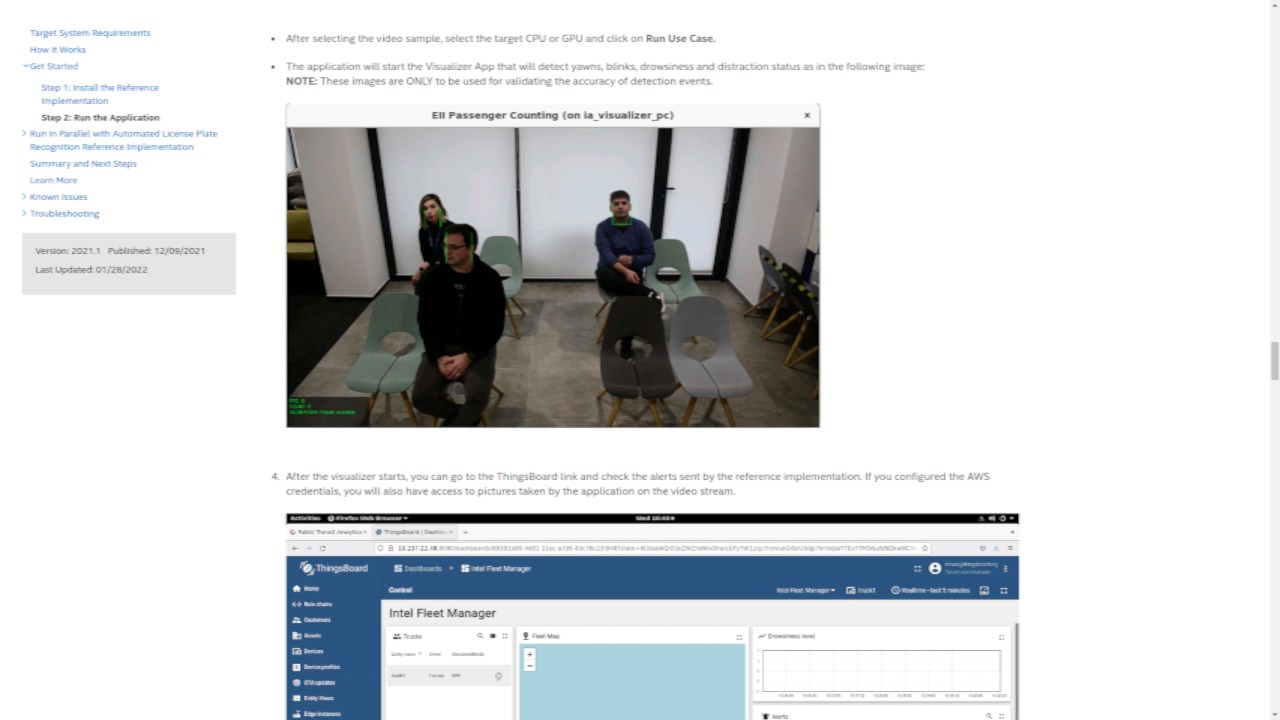
Agent build and provenance
See the full provenance
The layer-by-layer build, the evidence behind each claim, the risk basis and the cross-marketplace links are open to any account. Some rows are disclosed, some the source leaves Unknown; a free account shows you which.
Compliance
- FedRAMPConfirmedNot listed90%, registry-checkedNo FedRAMP Marketplace entry matched this vendor's domain, checked 2026-08-27registry recordas observed 2026-08-27
Confirmed means matched to a public authoritative registry. Claimed means the vendor or its listing states it, not yet cross-checked. A framework not shown was not found in any source we hold, which is not evidence against it. Not listed means a scoped registry check found no match for this vendor's domain: a No is a scoped registry check, not a compliance judgment. Confidence bands: 95% domain-verified, 90% registry-checked, 80% self-attested, 70% weak signal. Self-attested items marked “vendor's site” are gathered from the vendor's own website and are not verified by us.
Plans and pricing as listed
2 listedSources
Publisher resources
6 linksLinked repositories
Unknown means this listing does not publish a repository. It is not a statement that the code is closed, and a linked repository is not a claim that the publisher wrote it: the registry computes that relationship privately and does not publish it.
Evidence risk is the share of the build you cannot see before you deploy, not a security rating. Sign in to see the layer-by-layer basis for this band.