
AiDAP – Agentic Migration and Modernization Platform
Aiden AI · Operations & Productivity
Certification per Microsoft Marketplace.
Evidence tier Source Confirmed · 7 captures on record
What the publisher says
As described on Microsoft Marketplace.
AiDAP is AidenAI’s unified agentic platform for enterprise technology migration and modernization. It helps transformation, architecture and engineering teams understand complex application estates, recover embedded business and technical knowledge, design target architectures, transform applications, integrations and data, validate migrated assets, and govern production deployment.
AiDAP supports customer-defined migration programs across heterogeneous technology estates without prescribing a source platform or target stack. It can work with custom and packaged applications, process and workflow solutions, enterprise platforms and extensions, APIs and integration landscapes, databases, files and analytical data estates.
Show the rest of the publisher’s description (15 more lines)
A coordinated team of AI agents executes the migration lifecycle. An Orchestration Agent plans work, routes tasks, manages state and applies approval gates. Specialized Discover, Design, Builder, Test and Deploy agents operate from shared application knowledge and memory. They use approved tools and reusable transformation recipes while maintaining traceability between source evidence, engineering decisions, generated assets and production outcomes.
DISCOVER
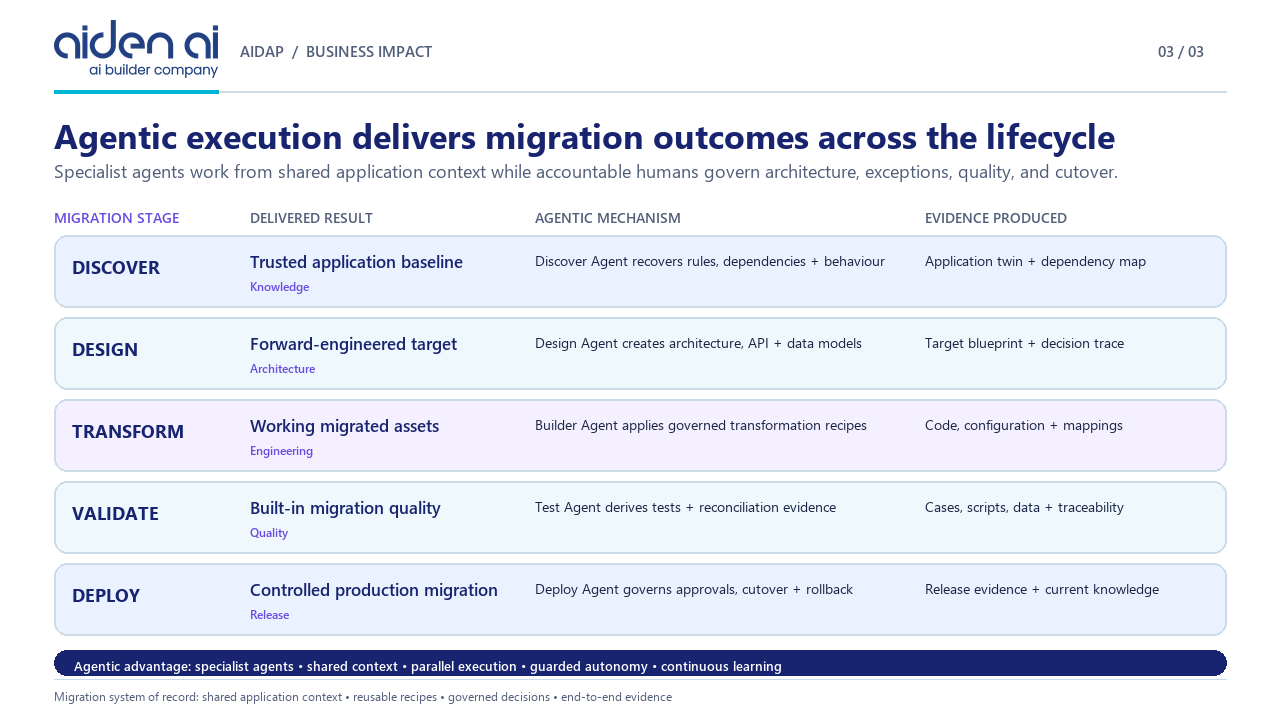
The Discover Agent ingests approved inputs such as source code, configurations, schemas, interfaces, documents, data and tickets. It identifies application components, dependencies, business rules, process behavior, data flows and technical risks. The results form a trusted application baseline and living application twin, consolidating knowledge fragmented across systems, documents and subject-matter experts.
DESIGN
The Design Agent uses discovered evidence and approved requirements to define the forward-engineered target state. Outputs can include application architecture, domain models, data models, API contracts, integration designs, security requirements and migration patterns. Design decisions remain connected to their source context, allowing teams to review rationale, dependencies and impact before transformation proceeds.
TRANSFORM
The Builder Agent generates or modifies target code, configuration, workflows, services, mappings and integrations using governed transformation recipes. These recipes capture repeatable engineering patterns while applying customer-specific standards, controls and selected target technologies. Generated assets remain connected to relevant source components, requirements and design decisions. Exceptions, unresolved dependencies and fit gaps are routed to authorized reviewers.
VALIDATE
The Test Agent derives validation scenarios from requirements, discovered business rules, observed application behavior and migrated assets. It can generate test cases, test scripts and synthetic data, and support regression testing, integration testing, fit-gap analysis and data reconciliation. Validation evidence remains linked to migrated components and originating requirements, providing a traceable basis for assessing completeness, functional equivalence and release readiness.
DEPLOY
The Deploy Agent supports the controlled movement of validated assets into customer environments. It can produce environment and CI/CD configurations, coordinate approval gates, and support cutover and rollback activities. Release evidence, approvals and migration decisions are retained in the shared application knowledge base.
AiDAP produces reusable migration assets rather than disconnected analysis documents. Depending on scope, outputs can include estate inventories, dependency and lineage maps, business-rule and process models, application twins, target architectures, API and canonical data models, migrated code and configuration, transformation mappings and recipes, test cases and scripts, synthetic data, reconciliation evidence, CI/CD templates, environment configurations, cutover controls, rollback plans, and current technical documentation.
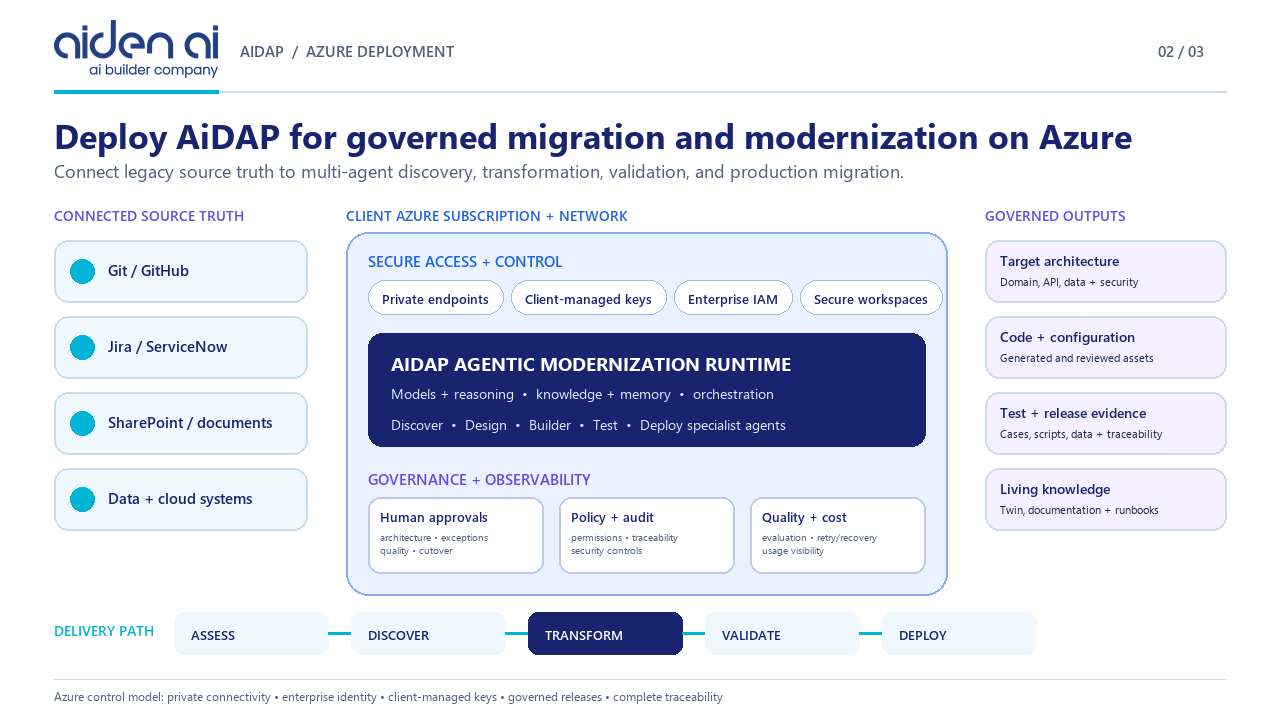
Human oversight is embedded throughout the lifecycle. Architecture decisions, generated assets, exceptions, security controls, quality gates and production releases can be subjected to defined roles, permissions and approvals. Agent activities, generated assets and engineering decisions remain traceable and auditable.
AiDAP can operate in an AidenAI-managed environment or within a customer-controlled Azure environment. Azure deployments can incorporate private connectivity, enterprise identity integration, customer-managed keys, secure workspaces and customer-defined governance controls.
By combining specialized AI agents, shared application context, reusable migration recipes and governed execution, AiDAP turns migration into a repeatable enterprise capability. It preserves critical knowledge, accelerates engineering work, embeds validation and maintains organizational control from estate discovery through production deployment.
Preview
3 images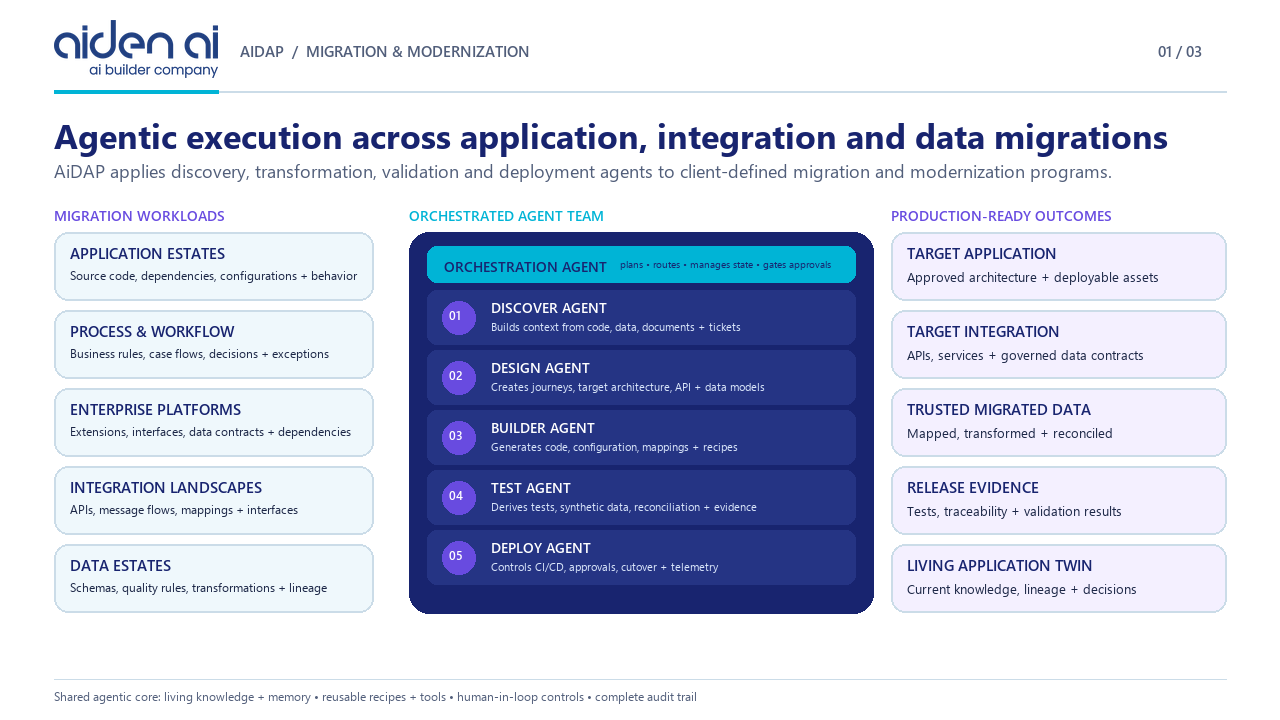
Agent build and provenance
See the full provenance
The layer-by-layer build, the evidence behind each claim, the risk basis and the cross-marketplace links are open to any account. Some rows are disclosed, some the source leaves Unknown; a free account shows you which.
Compliance
- FedRAMPConfirmedNot listed90%, registry-checkedNo FedRAMP Marketplace entry matched this vendor's domain, checked 2026-08-27registry recordas observed 2026-08-27
Confirmed means matched to a public authoritative registry. Claimed means the vendor or its listing states it, not yet cross-checked. A framework not shown was not found in any source we hold, which is not evidence against it. Not listed means a scoped registry check found no match for this vendor's domain: a No is a scoped registry check, not a compliance judgment. Confidence bands: 95% domain-verified, 90% registry-checked, 80% self-attested, 70% weak signal. Self-attested items marked “vendor's site” are gathered from the vendor's own website and are not verified by us.
Vendor
External enrichment
Sources
Publisher resources
1 linkLinked repositories
Unknown means this listing does not publish a repository. It is not a statement that the code is closed, and a linked repository is not a claim that the publisher wrote it: the registry computes that relationship privately and does not publish it.
Evidence risk is the share of the build you cannot see before you deploy, not a security rating. Sign in to see the layer-by-layer basis for this band.