

SOC Weekly Brief Agent
adaQuest · Cybersecurity & IT
Certification per Microsoft Marketplace.
Evidence tier Source Confirmed · 7 captures on record
What the publisher says
As described on Microsoft Marketplace.
SOC Weekly Brief Agent helps SOC Leads, SOC Managers, and service delivery teams generate a structured weekly security operations briefing with week-over-week comparison. The agent reduces manual reporting effort and provides leadership-ready insights across incident lifecycle, queue health, alert trends, detection drivers, recurring entities, automation health, Security Operations Efficiency, MITRE ATT&CK-oriented trends, operational projections, and recommended SOC Manager actions.
Input
Show the rest of the publisher’s description (30 more lines)
The agent does not require operational runtime inputs for the standard weekly brief. Each scheduled or manual execution analyzes the current calendar week and compares it with the previous completed week. The weekly model starts on Sunday at 00:00 UTC. If the current week is still in progress, the agent identifies it as a partial week.
For Chat with agent, users may ask natural language follow-up questions about week-over-week changes, high-priority incidents, detection drivers, SecOps Efficiency metrics, MITRE tactics, recurring entities, tuning candidates, service review notes, operational projections, or CISO-ready summaries.
Task
The agent collects and correlates available security operations data from the unified Microsoft security operations experience, using Microsoft Defender XDR signals and onboarded Microsoft Sentinel data when available through the unified portal. It summarizes and compares current-week and previous-week activity across incident lifecycle, severity, status, queue health, alert trends, detection drivers, recurring entities, high-priority incidents, backlog indicators, automation health, closure classifications, product trends, and MITRE ATT&CK-oriented activity.
The agent calculates or reports metrics such as Mean Time to Triage, Mean Time to Closure, High-severity Mean Time to Closure, incidents by closing classification, incidents by product, and incidents by MITRE tactic. If required data is unavailable, the agent states the limitation instead of estimating or fabricating metrics.
The agent is read-only. It does not close incidents, assign owners, isolate devices, disable users, modify analytics rules, configure suppressions, run remediation actions, or execute playbooks.
Outputs
The agent produces a structured weekly SOC leadership briefing that may include:
- Executive Summary
- Week-over-Week Decision Snapshot
- Service Value and Operational Evidence Highlights
- Weekly Incident Lifecycle and Queue Health
- Security Operations Efficiency
- Severity, Status, and Backlog
- Incident and Alert Trends
- Detection Drivers
- MITRE ATT&CK and Detection Trends
- Recurring Entities and Repeated Patterns
- High-Priority Items Requiring Attention
- Automation and Workflow Health
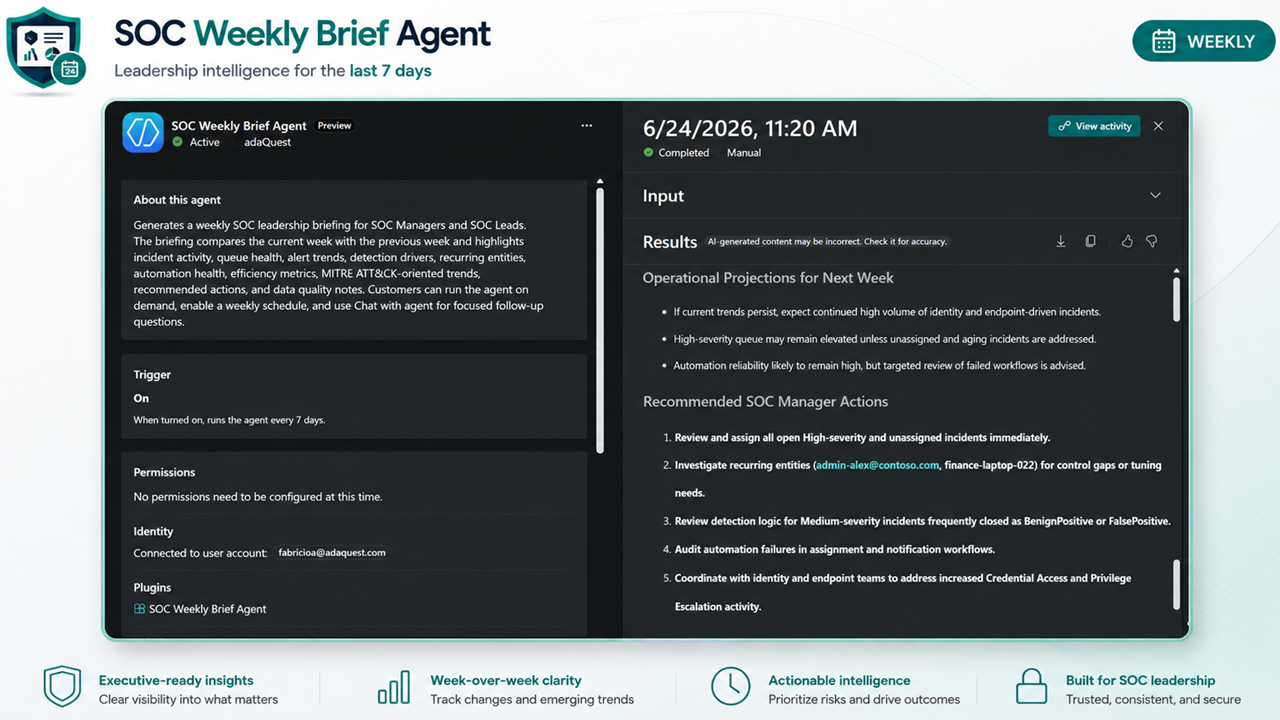
- Operational Projections for Next Week
- Recommended SOC Manager Actions
- Audit, Evidence, and Data Quality Notes
The Chat with agent experience allows users to ask follow-up questions, clarify metrics, review tuning candidates, prepare service review notes, summarize findings for leadership, or identify next-week SOC priorities.
Required products and permissions
The customer requires Microsoft Security Copilot with available SCU capacity and Microsoft Defender XDR access through the unified Microsoft security operations experience. Microsoft Sentinel data is optional and used when onboarded and available through the unified portal. Recommended access includes Security Copilot workspace access, read access to relevant Defender XDR data, and appropriate Defender XDR Unified RBAC permissions. Global Administrator is not required.
Estimated SCU consumption
Initial measured consumption is approximately 0.4 SCU per full scheduled or manual execution and approximately 0.1 SCU per Chat with agent interaction. Actual consumption may vary by tenant size, incident volume, telemetry availability, and chat complexity.
Version history / change log
1.0.0 - Initial marketplace release. Includes weekly SOC leadership briefing, current-week versus previous-week comparison, manual and scheduled execution, Chat with agent follow-up, unified security operations signal analysis, SecOps Efficiency metrics, MITRE ATT&CK-oriented trends, automation health, operational projections, recommended SOC Manager actions, and audit/data quality notes.
Preview
5 images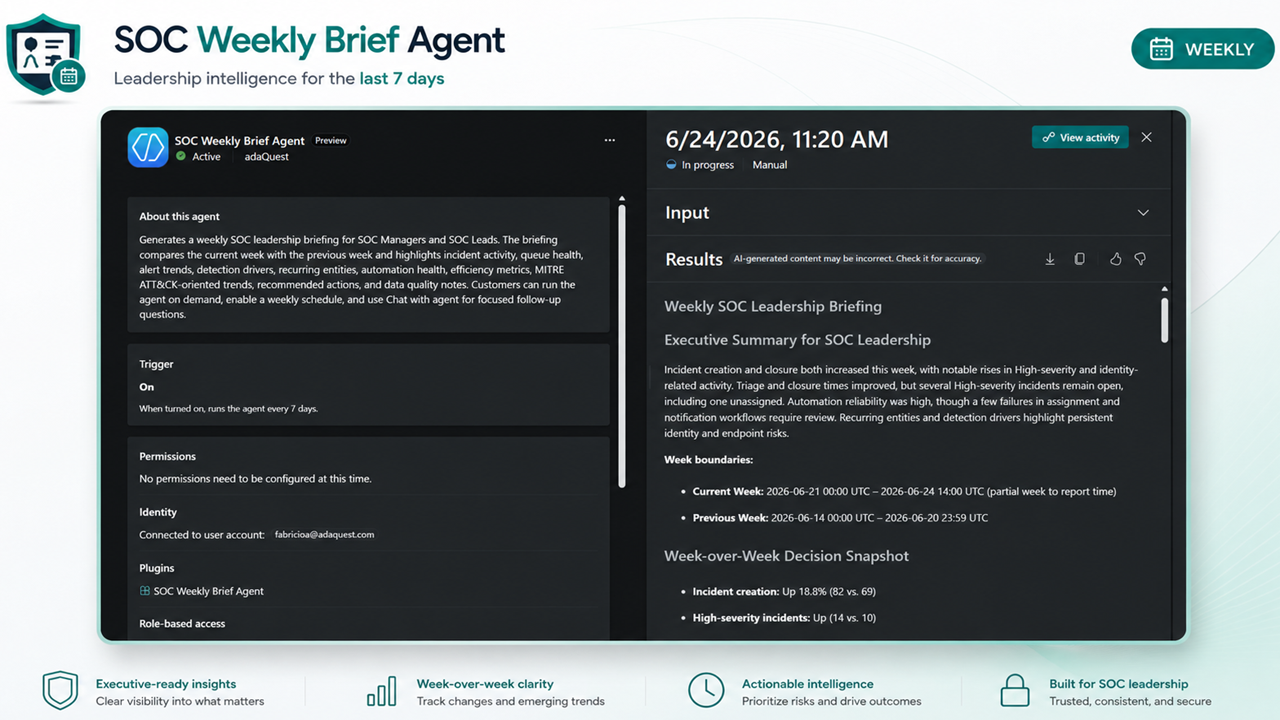
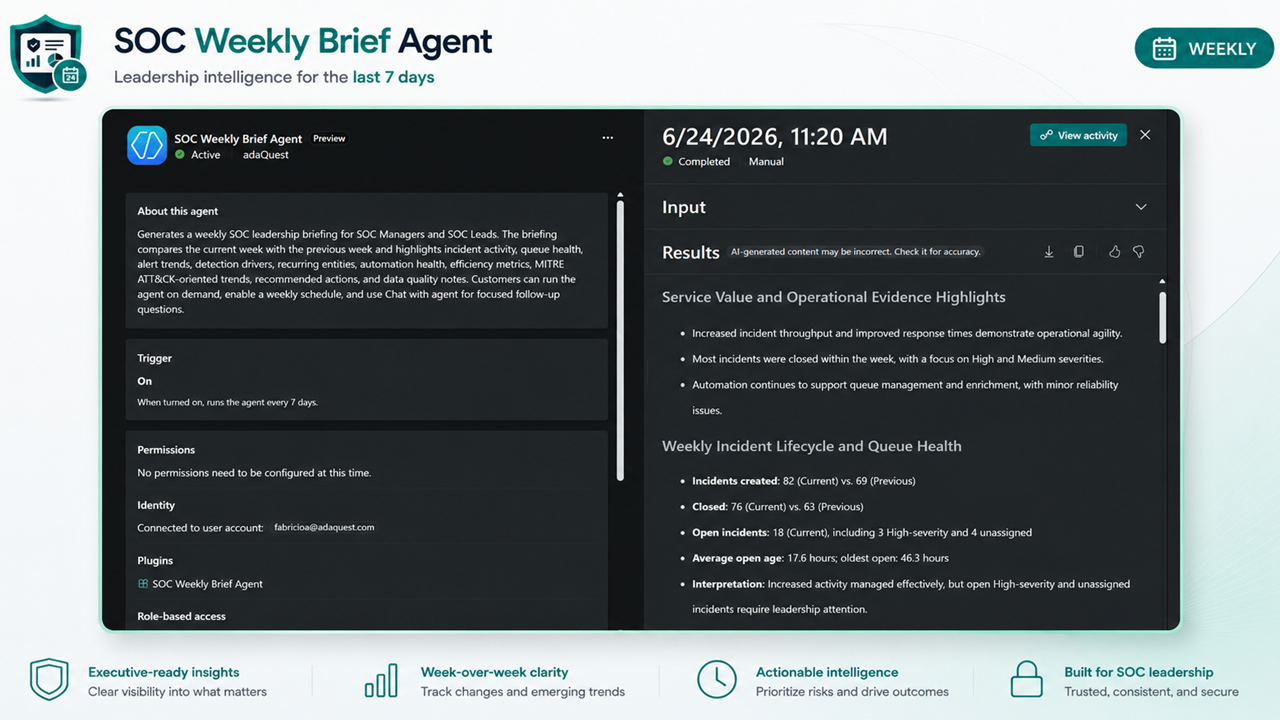
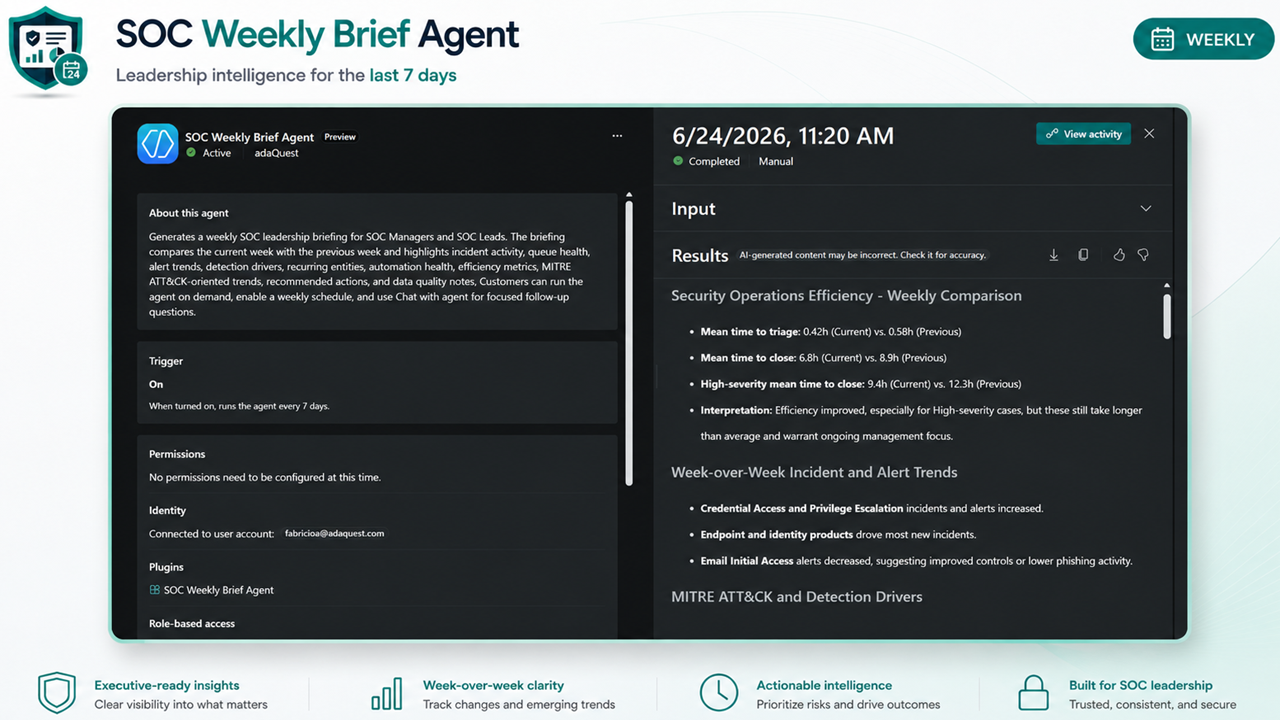
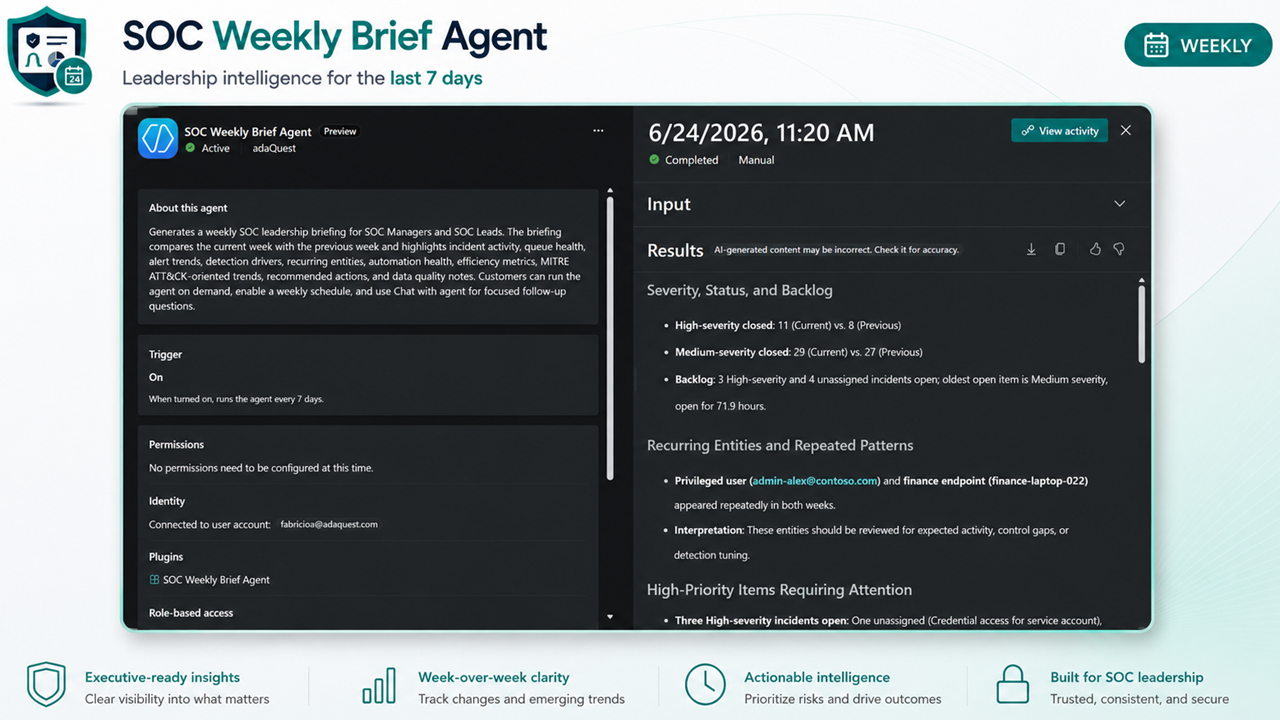
Agent build and provenance
Sign in to see the provenance.
The evidence, the layer-by-layer tracing, the risk basis, and the cross-marketplace links are open to signed-in accounts.
Sign inCompliance
- FedRAMPConfirmedNot listed90%, registry-checkedNo FedRAMP Marketplace entry matched this vendor's domain, checked 2026-08-27registry recordas observed 2026-08-27
Confirmed means matched to a public authoritative registry. Claimed means the vendor or its listing states it, not yet cross-checked. A framework not shown was not found in any source we hold, which is not evidence against it. Not listed means a scoped registry check found no match for this vendor's domain: a No is a scoped registry check, not a compliance judgment. Confidence bands: 95% domain-verified, 90% registry-checked, 80% self-attested, 70% weak signal. Self-attested items marked “vendor's site” are gathered from the vendor's own website and are not verified by us.
Vendor
External enrichment · as of 2026-08-29
Plans and pricing as listed
1 listedSources
Publisher resources
2 linksEvidence risk is the share of the build you cannot see before you deploy, not a security rating. Sign in to see the layer-by-layer basis for this band.